














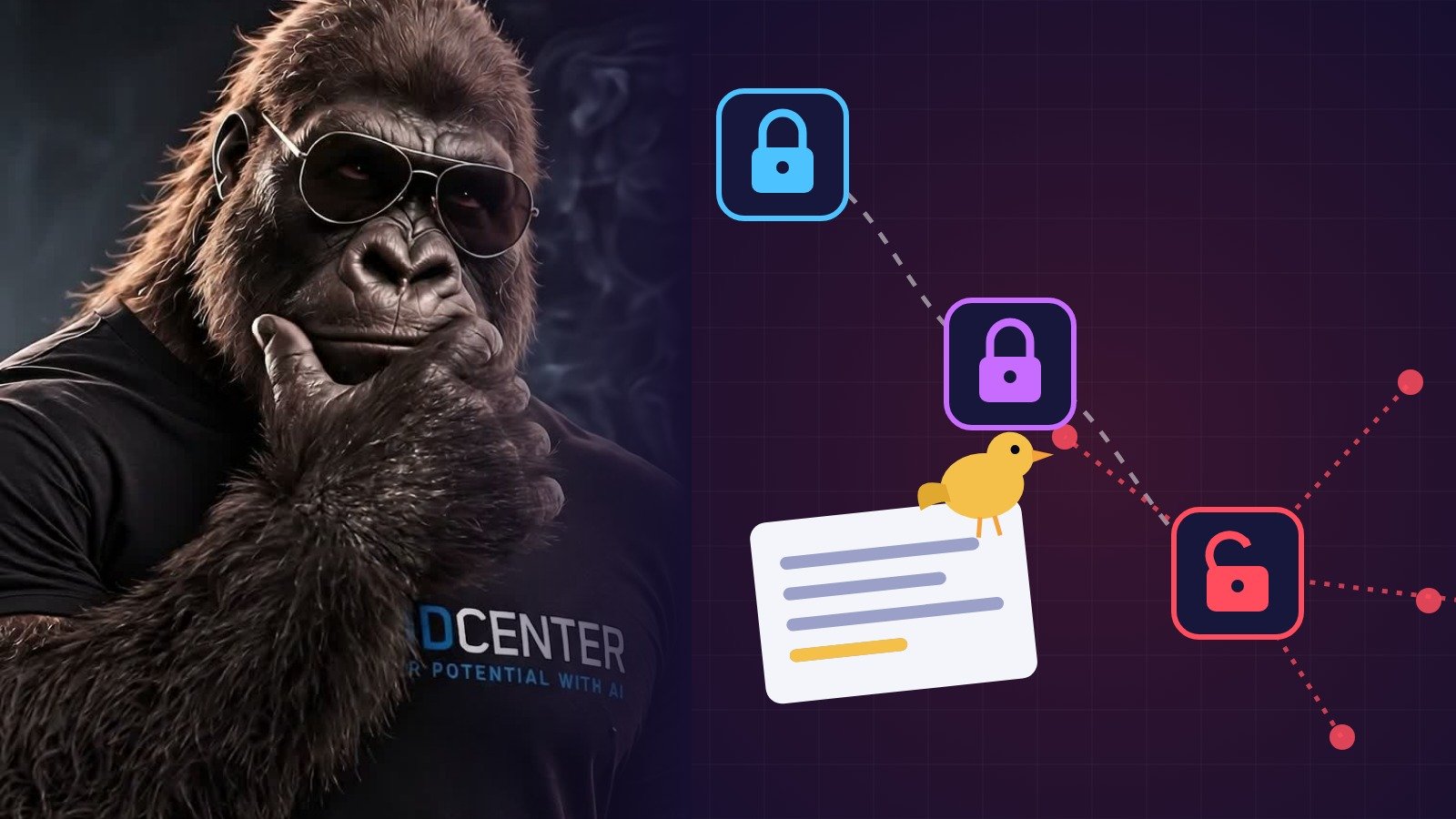
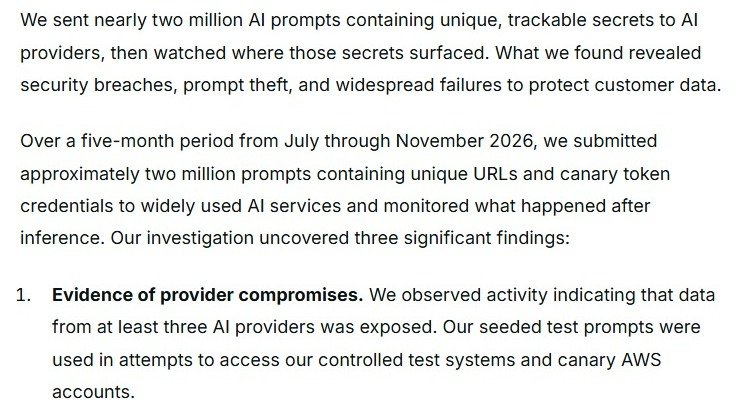
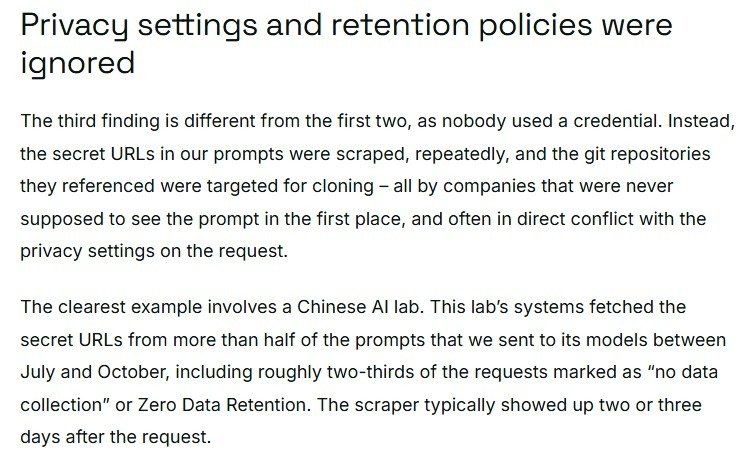
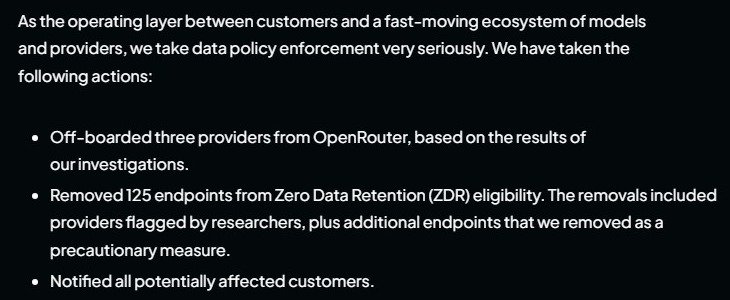
On November 19, security firm Dragos reported that over five months it sent about two million prompts seeded with trackable secrets to widely used AI services. One Chinese AI lab, which Dragos does not name, fetched the secret URLs from more than half of the prompts sent to its models, including roughly two-thirds of the requests marked “no data collection” or Zero Data Retention (ZDR). On November 22, OpenRouter said it off-boarded three providers and removed 125 endpoints from ZDR eligibility.
We did not test anything. This post joins the primary sources and turns them into a method you can run on your own setup. The time estimates below are ours, not measured.
The facts
- Dragos: “at least three AI providers” had data exposed. The scraper “typically showed up two or three days after the request.” Its summary: “a privacy flag only binds the first hop.”
- Dragos: prompts sent to several U.S. hosting providers that resell that lab’s models triggered the exact same scraper, and Dragos says the prompts were flowing back to the lab.
- OpenRouter: three providers off-boarded, 125 endpoints removed from ZDR eligibility, all potentially affected customers notified. It says the findings “did not show any breach or unauthorized access of OpenRouter.” It will require assurances before restoring ZDR eligibility.
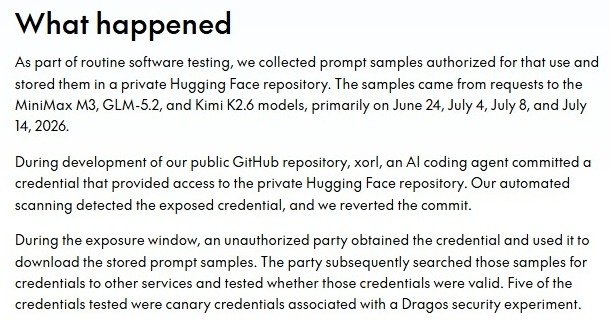
- Together AI: an AI coding agent committed a credential to a public GitHub repository. It gave access to a private Hugging Face repository holding prompt samples (MiniMax M3, GLM-5.2, Kimi K2.6). Five credentials tested by the third party were Dragos canaries.
- Novita: a routing error sent some MiniMax requests to MiniMax’s official API instead of Novita’s own infrastructure.
What it changes: a 5-step check
If you build apps, automations or game features that call models through an API or a router, or you are a solo founder with agents doing real work, the flag in your settings is a promise made at the first hop. Here is how to check it.
| Step | What to do | Time (our estimate) |
|---|---|---|
| 1 | Draw the path: your app, router, provider | 3 min |
| 2 | Turn ZDR on in the account and per request | 2 min |
| 3 | Plant a free canary in your agents’ context | 5 min, then wait days |
| 4 | Remove real secrets from agent context | varies |
| 5 | Rotate credentials if you used MiniMax via Novita | 10 min per credential |
1. Know where your requests go. Dragos says every hop “can see the entire prompt and response.” Write down each hop between your code and the model that answers. If you use a router, your provider is whoever the router picked, unless you chose.
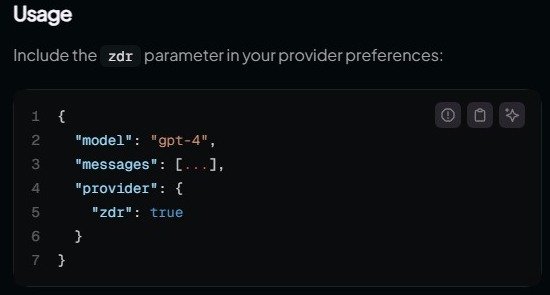
2. Turn ZDR on, twice. OpenRouter’s docs say you can enforce ZDR globally, per model group, per guardrail or per request. The request-level setting works as an “OR” with your account settings, so it can add protection but never remove it. Account settings live at openrouter.ai/settings/privacy. Per request:
{
  "model": "gpt-4",
  "messages": [...],
  "provider": { "zdr": true }
}
Remember the lesson: the flag covers the first hop, and in the Dragos study one lab’s systems still fetched the secret URLs for about two-thirds of the requests marked ZDR or “no data collection”.
3. Plant your own canary. A canary token is a secret that exists in one place only, so any use tells you that place leaked. Dragos says a free Canarytoken from Thinkst “is enough to get started today.” We checked only that canarytokens.org loads and describes itself as a free tool that notifies you when a trap is triggered. We did not create a token, so we give no menu names. In general: create one fake credential or secret URL, tell the service where to send alerts, and paste it into the context one agent sends, labelled so you know where you planted it. Use a different one per agent. Treat any alert as an incident. Be patient: in the study the scraper arrived two or three days later, and one stolen AWS key was first used the next day and still in use three weeks later.
4. Take real secrets out of agent context. The Together case is the reminder: an AI coding agent committed a real credential. If your agents need an API key, give them a scoped, short-lived one, never a master key. Dragos says secret filtering “can’t hurt” but is “not a panacea.”
5. If you used MiniMax through Novita, including via OpenRouter, between 2026-05-28 and 2026-11-11, Novita says your request contents may have been accessed or retained by a third party. It recommends revoking or rotating any credentials that went in those requests.
The exposure ladder
Dragos lists options from most to least protected: host the model yourself (only for your most sensitive work, from $22,299 for a Mac Studio 512 GB or $6,950 for a DGX Spark), go direct to a first-tier provider, or use a router while choosing your upstream providers instead of the default pool, checking that privacy settings really change where requests go, and avoiding resale marketplaces.
Who should ignore this
If you only paste non-sensitive text into a chat app, steps 3 to 5 are overkill. If your prompts carry customer data, keys or private repository links, do all five this week.
Sources
- HD Moore, Dragos, “Three breaches, endless leaks: Your AI supply chain needs canaries” (Nov 19, 2026), original study: https://www.dragos.com/blog/ai-supply-chain-security-canary-tokens
- OpenRouter, “Data processing incidents on inference providers” (Nov 22, 2026): https://openrouter.ai/blog/announcements/data-processing-incidents-on-inference-providers/
- Vipul Ved Prakash, Together AI, security event notice (Nov 21, 2026): https://www.together.ai/blog/security-event-prompt-leakage-for-requests-in-june-and-july-of-2026
- Novita, MiniMax requests privacy notice (Nov 22, 2026): https://novita.ai/blog/minimax-requests-privacy-notice/
- OpenRouter docs, ZDR: https://openrouter.ai/docs/guides/features/zdr
- Canarytokens by Thinkst: https://canarytokens.org/
- Hacker News discussion: https://news.ycombinator.com/item?id=50595554
- Screenshots captured by us from the pages above. Their images belong to Dragos, OpenRouter and Together AI.