
















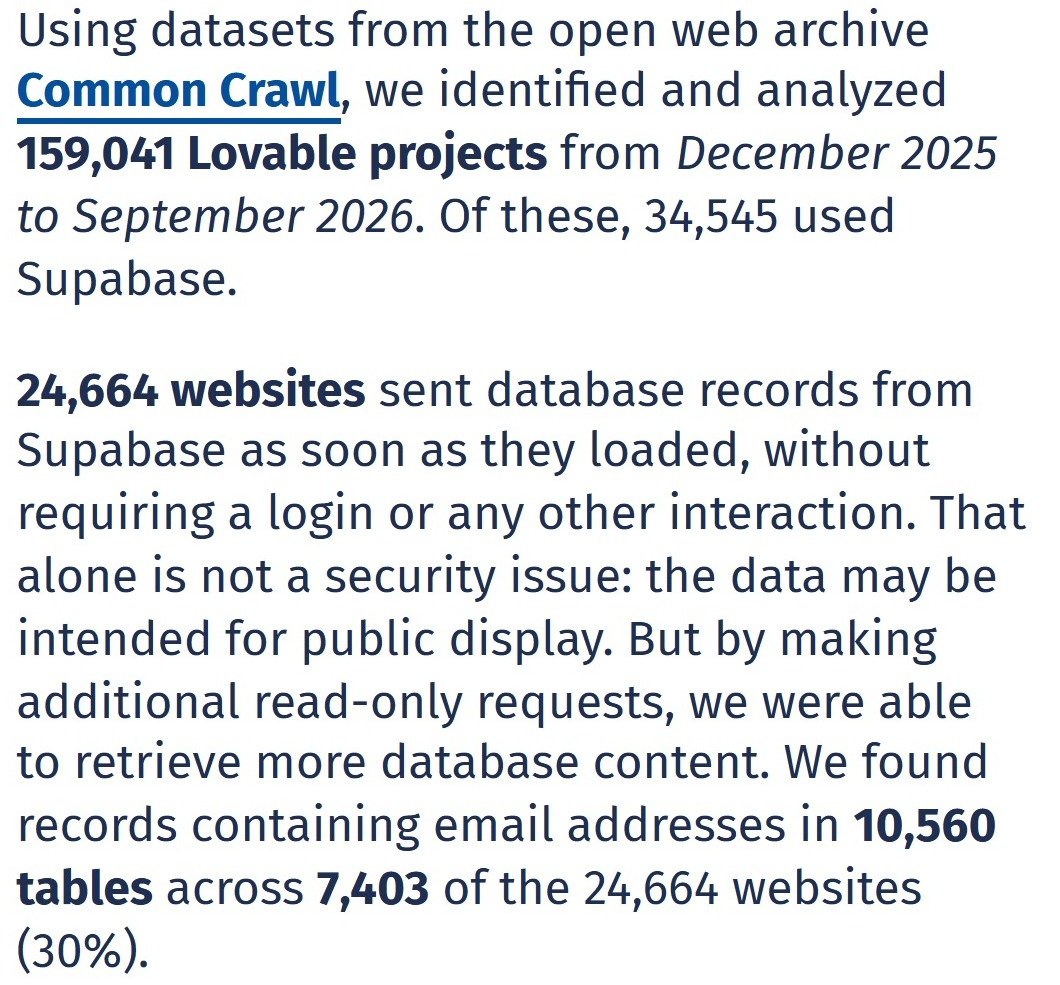
A study by Crissy Field GmbH looked at 159,041 Lovable projects. Of the 34,545 that used Supabase, 24,664 websites sent database records as soon as they loaded, without any login. The study then found records with emails in 10,560 tables across 7,403 of those sites, about 30%.
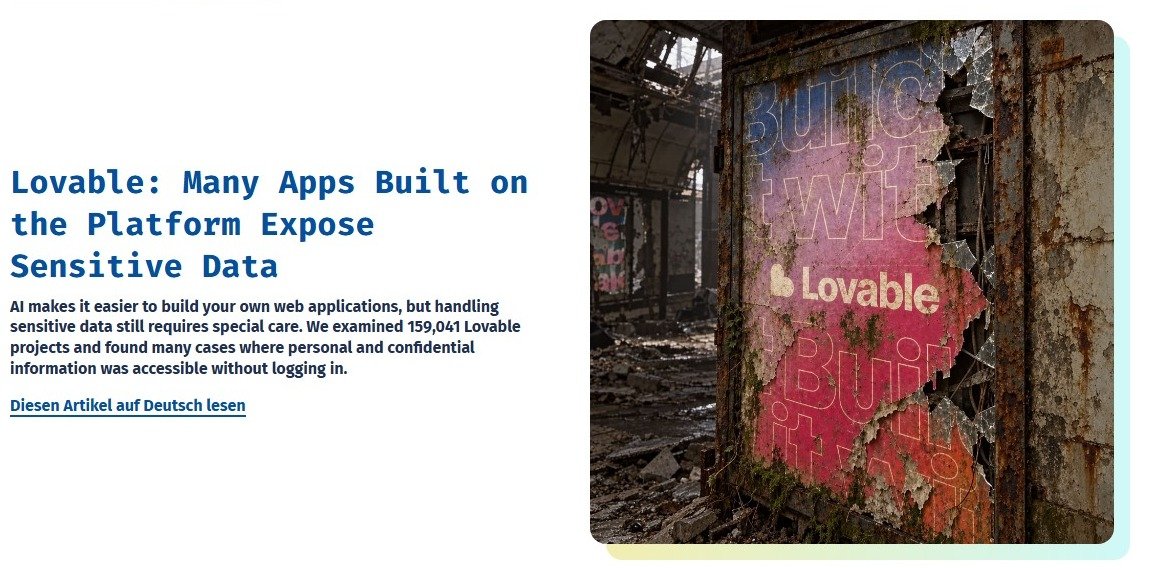
That 30% is not a leak rate, and the report says so itself. Below: what the numbers say, what they do not, and the check you can run on your own app in two minutes.
The facts
- Sample. 159,041 Lovable projects found through Common Crawl, December 2025 to September 2026, per the Crissy Field report.
- Supabase. 34,545 of them used Supabase. 24,664 websites sent database records on load, without login. Same report.
- Emails. With extra read-only requests using the same API key, records with emails turned up in 10,560 tables across 7,403 of the 24,664 websites (30%). Same report.
- Cases in the report. A German lifestyle forum with more than 80,000 profiles and more than 200,000 chat messages. A provider with more than 1,000 identity document records, including passport numbers. 280,000 emails sent to a provider’s customers. Same report.
- Not examined. The researchers did not look at Lovable’s own database features, introduced in late 2025. The report says Handelsblatt contacted Lovable with the findings, and it says Lovable’s terms put responsibility for apps and data on the customer. Same report.
- Traction. The story reached 989 points on Hacker News (checked 16 Nov, 11:15 UTC).
What the number does not say
The report is careful here, and we should be too.
- Sending records without login “alone is not a security issue: the data may be intended for public display”. A public product list is meant to be public.
- The 30% “should therefore not be read as a confirmed data leak rate”.
- Common Crawl is not a representative sample, and the researchers downloaded only parts of the data.
- They do not know whether any data was misused.
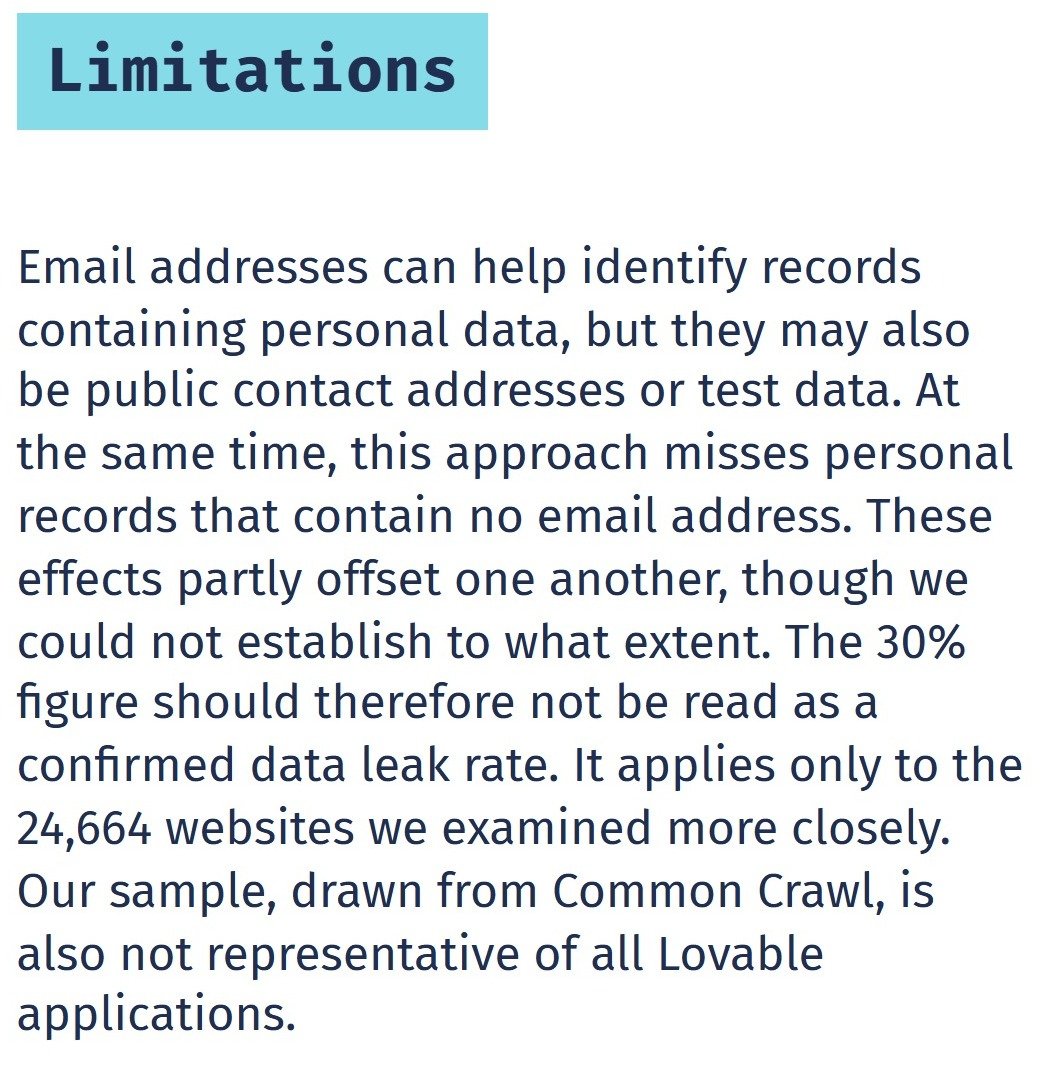
So the honest reading is: a large number of apps answer anonymous requests, and in a meaningful share of them the answer contains personal data. Whether yours does is something only you can check.
What it changes
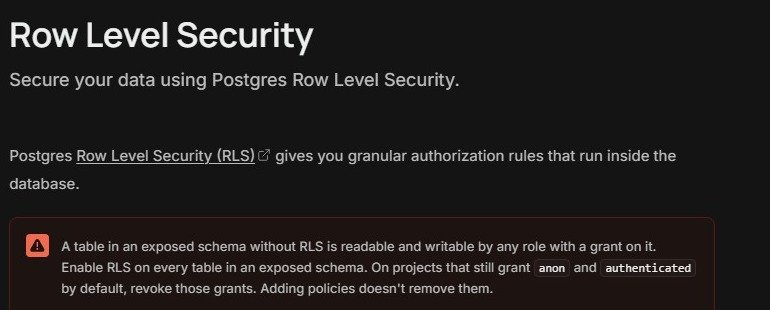
Solo founders and app developers with a Lovable and Supabase app: run the check below before you store real customer data. The Supabase docs are direct: “A table in an exposed schema without RLS is readable and writable by any role with a grant on it. Enable RLS on every table in an exposed schema.”
This is also our view from a company where agents do part of the work. If an agent generated your database and nobody reviewed the access rules, the review is now your job, and it takes minutes. Check only your own app.
Prerequisites
- Access to your own app and your own Supabase project dashboard.
- A browser with DevTools (Chrome, Edge or Firefox).
- Access to the Supabase SQL editor (for steps 4 and 6).
Step-by-Step
- Open your app logged out. Use a private window so no session is active.
- Open DevTools, Network tab. Reload the page.
- Filter by
supabase.co, then byrest/v1. Click each request and read the response. Ask one question: are these rows meant to be public? Product lists, yes. Customer names, emails, messages, no. - In the Supabase dashboard, open each table in the
publicschema. If RLS is off, turn it on, or run this for each table (the example is from the Supabase docs):
alter table public.reports enable row level security;- Write policies for what each table should allow. Per the docs, once RLS is on, no data is accessible through the API with a publishable key until you create policies. So turning it on first is the safe order, and your app may stop showing data until policies exist.
- Review grants for
anon. In the SQL editor, this standard Postgres query lists them (we did not run it on Supabase):
select table_name, privilege_type
from information_schema.role_table_grants
where grantee = 'anon' and table_schema = 'public';
If a table should not be readable by anonymous users at all, remove the grant:
revoke select on public.customers from anon;- Repeat step 3. The sensitive requests should now return empty lists or an error.
Our test
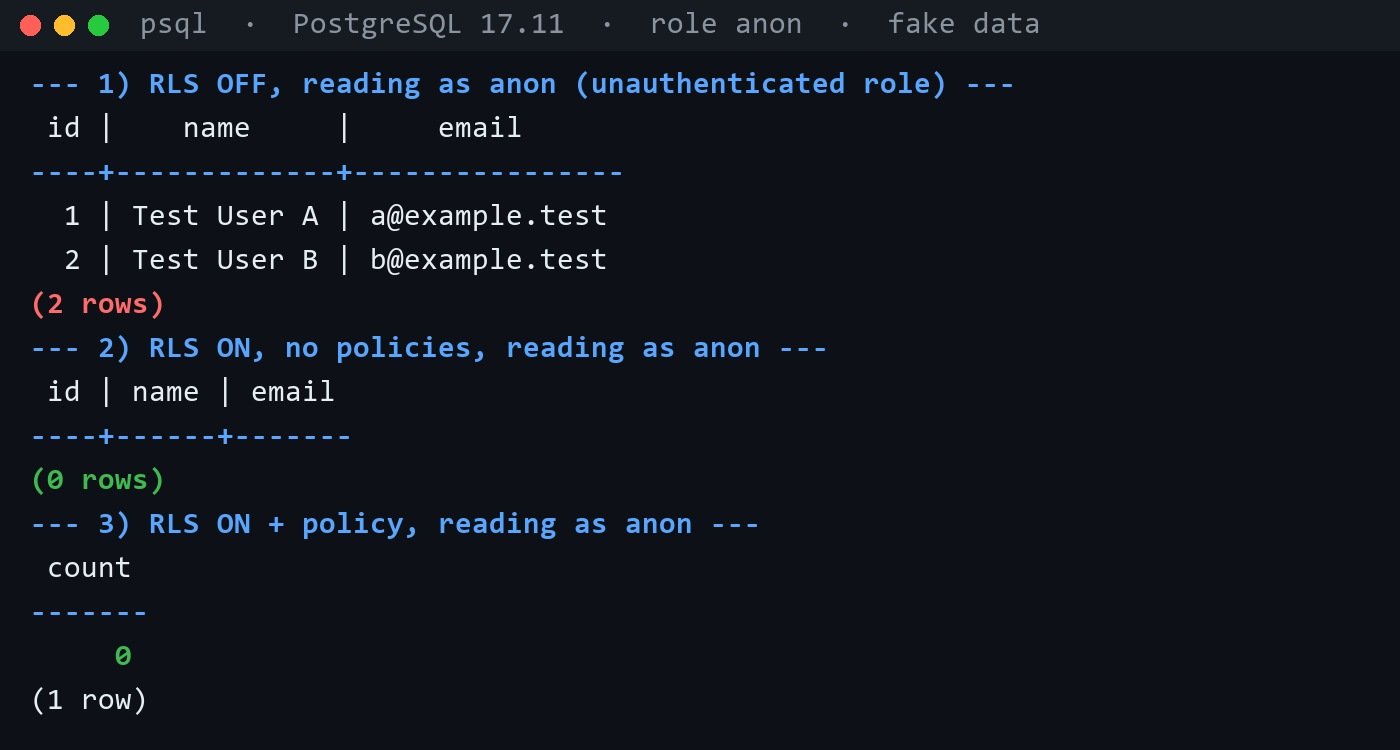
We tested the mechanism on a local PostgreSQL 17.11 in Docker, with fictional data. The anon role had a SELECT grant. Per the Supabase docs, anon is the role that unauthenticated requests are mapped to.
- RLS off:
anonread 2 rows, with name and email. - RLS on, no policies: 0 rows.
- RLS on plus a policy
using (false): 0 rows.
The script:
create role anon nologin;
create table public.customers (id int, name text, email text);
insert into public.customers values (1,'Test User A','a@example.test'),(2,'Test User B','b@example.test');
grant usage on schema public to anon;
grant select on public.customers to anon;
set role anon; select * from public.customers; reset role;
alter table public.customers enable row level security;
set role anon; select * from public.customers; reset role;
create policy "own rows" on public.customers for select to anon using (false);
set role anon; select count(*) from public.customers; reset role;
Honest limit: we tested the Postgres mechanism that Supabase relies on, not a Supabase project and not a Lovable app. Your own check in the steps above is the one that counts.
Our take
If your Lovable app only shows public content, you may have nothing to fix, and the check will tell you in two minutes. If it holds customer data, do it today.
Sources
- Lovable: Many Apps Built on the Platform Expose Sensitive Data, Crissy Field GmbH. The report cites Handelsblatt (Lina Knees, 2 Nov 2026) as having contacted Lovable.
- Row Level Security, Supabase docs
- Hacker News discussion
caption_instagram: | 24,664 Lovable apps sent database records without login.
That is 24,664 of 34,545 apps using Supabase, in a study of 159,041 projects. The 30% with emails is NOT a confirmed leak rate, the study says so itself.
What to do: open your app logged out, check the Network tab, and turn on RLS for every table. We tested it: RLS off, 2 rows. RLS on, 0 rows.
The full 2-minute playbook and the SQL are on the blog. Link in bio.
fontes:
- Crissy Field GmbH, relatório (fonte primária): https://www.crissyfield.de/research/lovable-en/
- Supabase docs, Row Level Security: https://supabase.com/docs/guides/database/postgres/row-level-security
- Hacker News, id 50499017: https://news.ycombinator.com/item?id=50499017
- Handelsblatt (Lina Knees, 2026-11-02), citado pelo relatório, não aberto por nós