
















According to Xusheng Li’s analysis, a Windows 11 component called MissionControlAggregator.dll keeps a list of coding agents and developer tools you have used and, where the feature is active, uploads it to Microsoft unless you have opted out of “optional” diagnostic data. That setting was on by default in the US setup he tested. The story passed 600 points and 470 comments on Hacker News (checked 17 Nov).
This is not about prompts or code, and the author says the feature is not active on every install. Below: what is on the list, what is and is not sent, a 3-command check, and how to turn it off.
The facts
- How he found it. The author asked an AI to scan recent Windows binaries for undocumented features. One result was a coding agent list in MissionControlAggregator.dll. Source: Xusheng Li.
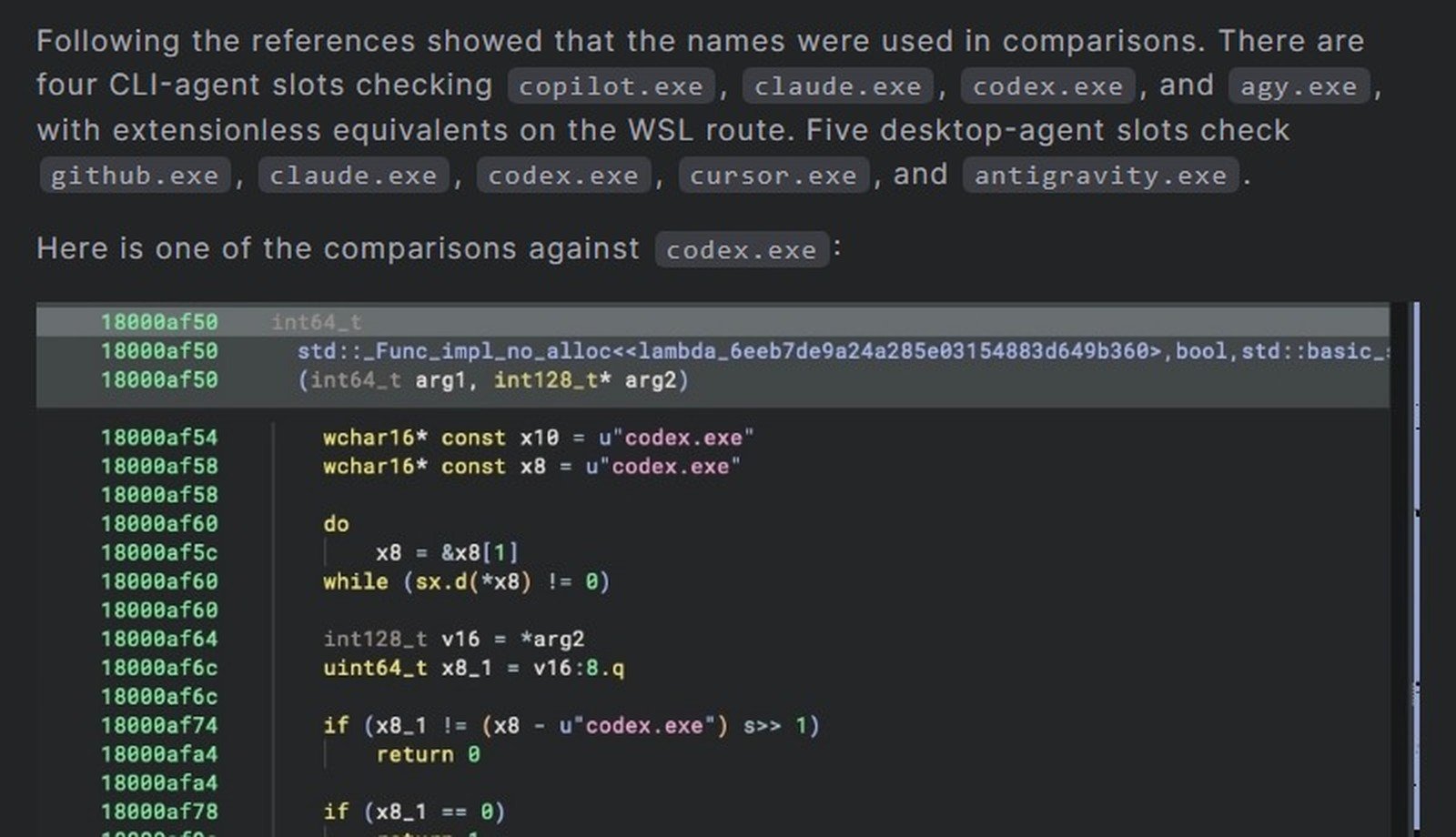
- Agents on the list. 4 CLI slots: copilot.exe, claude.exe, codex.exe, agy.exe (plus extension-less equivalents via WSL). 5 desktop slots: github.exe, claude.exe, codex.exe, cursor.exe, antigravity.exe. Same source.
- Dev tools. It also checks node.exe, python.exe, dotnet.exe, gcc.exe, clang.exe, gdb.exe, javac.exe, devenv.exe, code.exe and others, in 12 categories. Some also check the publisher (Node.js Foundation, Python Software Foundation, Microsoft Corporation for .NET and Visual Studio). Same source.
- How it works. It does not scan processes. It consumes events Windows already generates. The source events carry run time, focus time and interaction counts, but the component appears to discard them and keep only a bitmap of which agents were seen. Same source.
- What is sent. The author writes: “I found no prompt text or source code in this report”. The report is normally roughly daily. Same source.
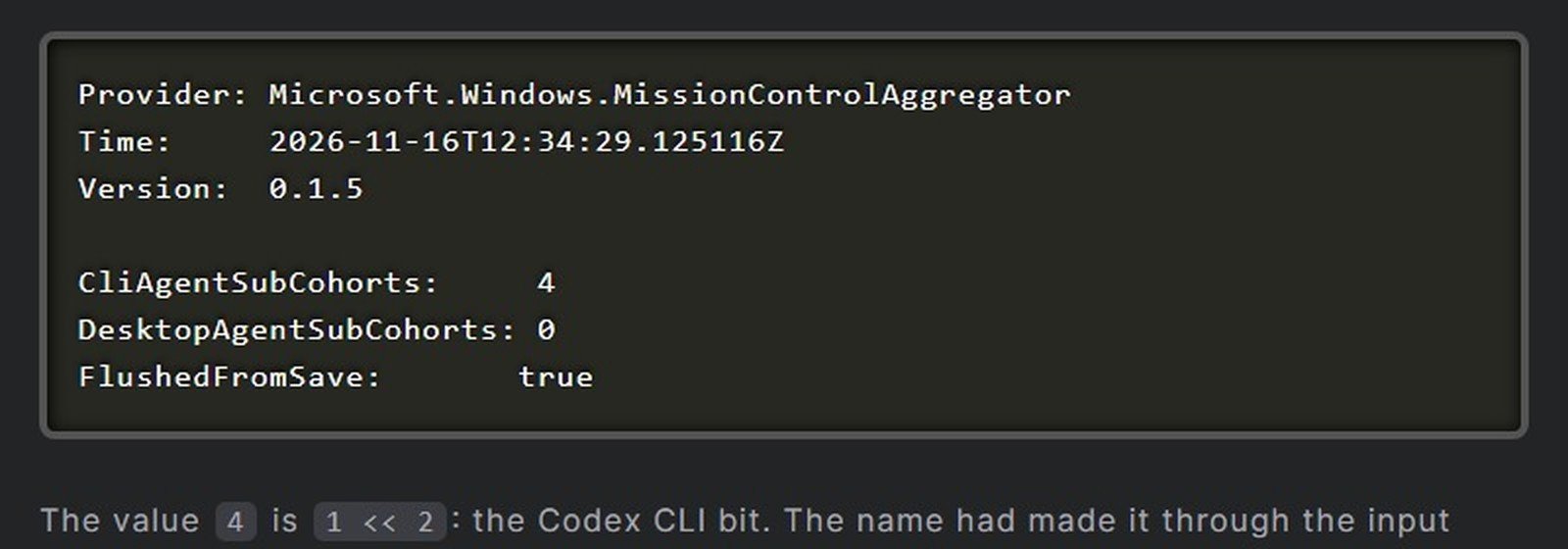
- His test. A copy of cmd.exe renamed codex.exe produced CliAgentSubCohorts: 4 (the Codex bit). The event sat in the DiagTrack upload queue marked “isRequired”: false, so it is optional data. Same source.
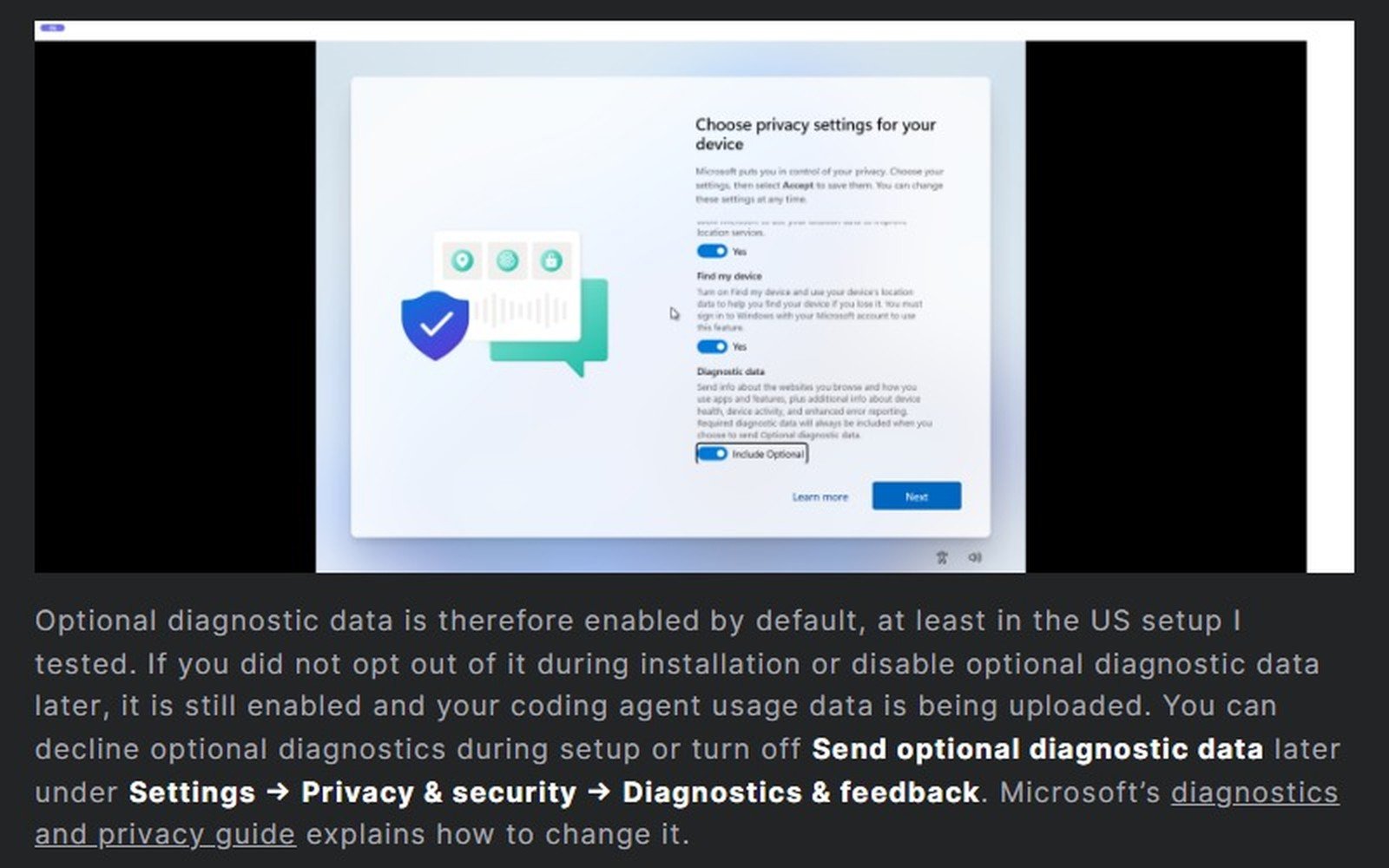
- Defaults. On a clean Windows 11 Home ARM64 install from the official ISO, US region, optional diagnostics were already on and AllowTelemetry was 3. He only confirmed this for the US setup. Same source.
- The caveat. The public ISO’s baseline VM had the feature disabled by image default, so in the author’s words the evidence does not support saying it is active on every Windows installation. Same source.
- Microsoft. As of 17 Nov we found no public response.
What it changes
App developers and solo founders using Claude Code, Codex, Copilot or Cursor: your tool names may be reported, not your work. The author found a bitmap of which tools were seen, with no prompt text and no source code. If your clients’ contracts or your own policy say that tool usage must stay private, check the setting below.
Game developers: gcc, clang, gdb and Visual Studio are on the list too.
If you delegate work to agents: according to the analysis, the operating system can keep a tally of which agents ran on a machine. For a company where agents do part of the work, that is worth knowing, even if the data is small.
Everyone else: low risk, but the default in the US setup was optional data on, and it takes one setting to turn off. The feature depends on optional diagnostics, which you can turn off in one setting.
Our test
We read, without changing anything, a Windows 11 Pro 26H2 machine (build 26300.9711).
- C:\Windows\System32\MissionControlAggregator.dll exists, version 10.0.26100.9549.
- A UTF-16 text search found codex.exe, claude.exe, copilot.exe, cursor.exe, antigravity.exe, agy.exe, github.exe, dotnet.exe and devenv.exe. The strings SubCohorts and CliAgentSubCohorts are there too.
- DiagTrack is Running and Automatic, and an AggregatorHost process is running.
- AllowTelemetry is 1 here, with optional diagnostics off.
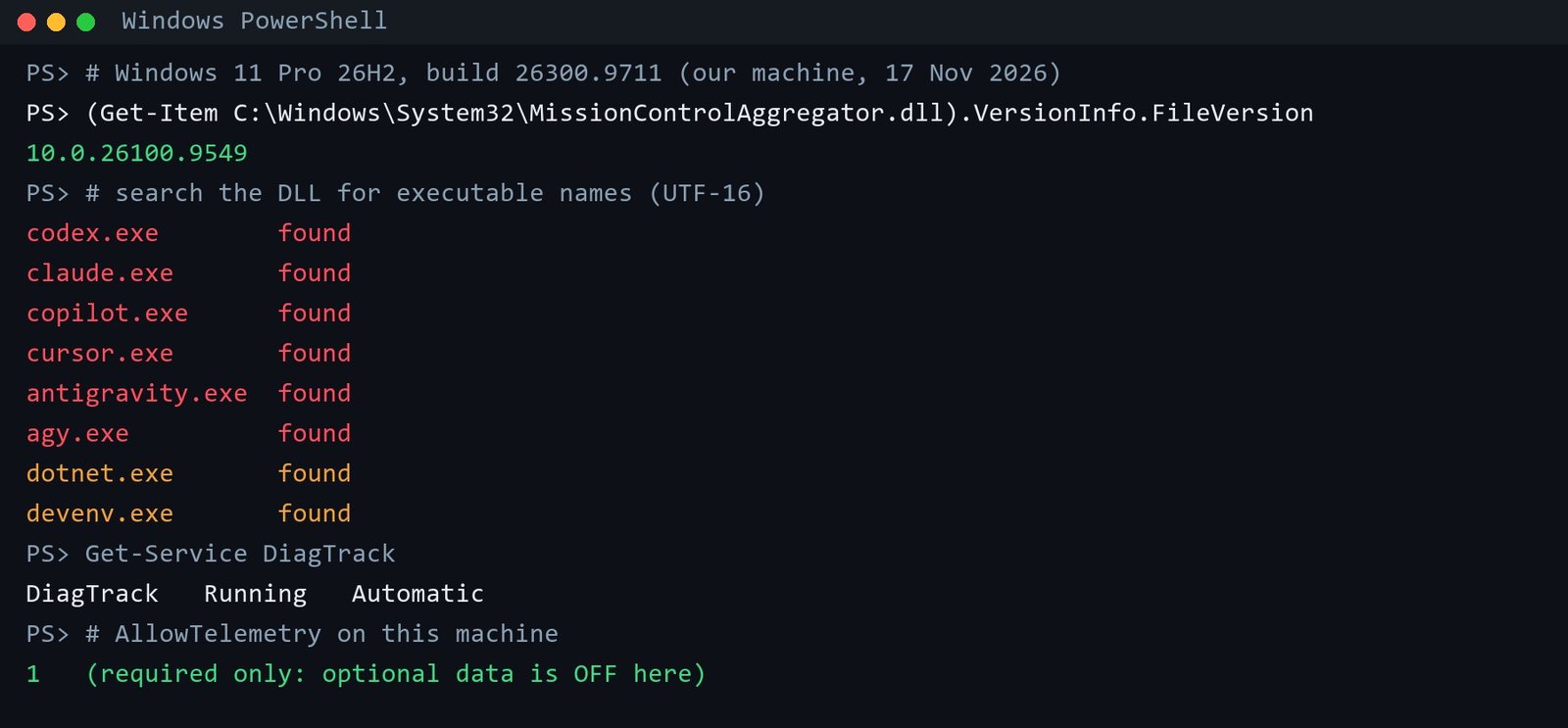
Honest limit: without admin rights we could not see whether the DLL is loaded or whether the feature is active on this machine, so we do not claim either. What we can say is that the list of names is in Windows 11 26H2 Pro too, not only in the author’s build. Whether a report is sent depends on the feature being active and optional diagnostics being on.
Check and turn it off
Prerequisites
- Windows 11 and PowerShell. Reading is enough, no admin rights needed.
Step-by-Step
- Check the DLL version. This shows whether the file exists on your PC.
(Get-Item "C:\Windows\System32\MissionControlAggregator.dll").VersionInfo- Search the DLL for an agent name.
Truemeans the name is in the file. It does not mean the feature is active.
[Text.Encoding]::Unicode.GetString([IO.File]::ReadAllBytes("C:\Windows\System32\MissionControlAggregator.dll")).Contains("codex.exe")- Read your diagnostic level. The author saw 3 with optional diagnostics on. We saw 1 with optional diagnostics off.
Get-ItemProperty HKLM:\SOFTWARE\Microsoft\Windows\CurrentVersion\Policies\DataCollection | Select AllowTelemetryIf the command returns nothing on your PC, use the Settings page in step 4 to check instead.
- Turn off optional data. Open Settings, then Privacy & security, then Diagnostics & feedback, and switch off “Send optional diagnostic data”. Microsoft’s guide: Diagnostics, feedback and privacy in Windows. You can also decline the optional data during setup.
We ran steps 1 to 3 on our machine. We did not change any setting.
Our take
It is a bitmap of tool names, not your code, and it may not even be active on your PC. Still, if you use coding agents for work you are not ready to disclose, turning off optional diagnostics costs nothing. Everyone else can check the setting once and move on.
Sources
- Xusheng Li, “Windows 11 is collecting data on which coding agents and developer tools you use” (CC BY-NC 4.0). Primary source.
- Hacker News discussion (624 points, 478 comments, checked 17 Nov).
- Microsoft, Diagnostics, feedback and privacy in Windows