


















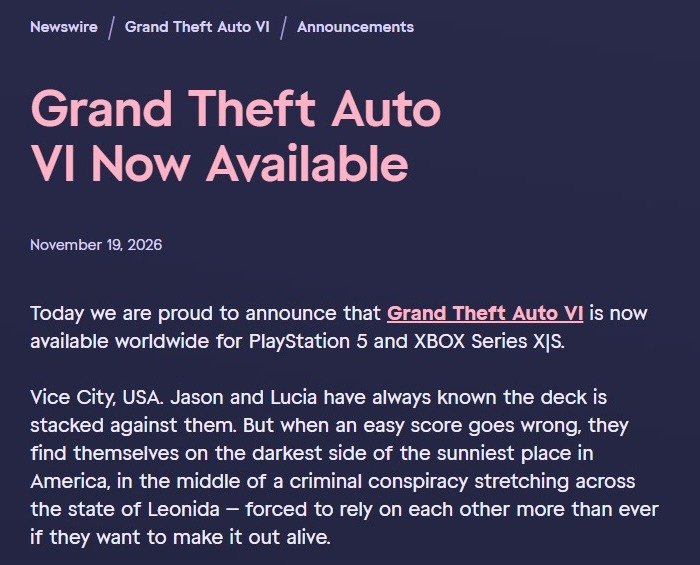
Grand Theft Auto VI became available worldwide on 19 November 2026, according to Rockstar’s newswire. Its publisher’s CEO has said generative AI “has zero part” in what Rockstar is building, while the same company runs “hundreds of pilots” of AI. That sounds like a contradiction. It is a line between AI as a tool and AI as content, and Steam draws the same line in the rules every developer accepts before selling a game there.
This post turns that line into a working method for your own game: a five-step AI ledger, a template you can copy, and a small script we tested that turns the ledger into a first draft of your Steam answer.
What Take-Two said
All quotes are from Strauss Zelnick, CEO of Take-Two, in an interview with GamesIndustry.biz on 3 February 2026, before launch:
- “Specifically with regards to GTA 6, Generative AI has zero part in what Rockstar Games is building. Their worlds are handcrafted.”
- “Right now we have hundreds of pilots and implementations across our company, including within our studios. And we’re already seeing instances where generative AI tools are driving costs and time efficiencies.”
- “We use tools to do everything we do… tools don’t replace creativity.”
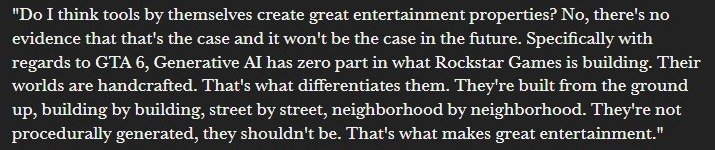
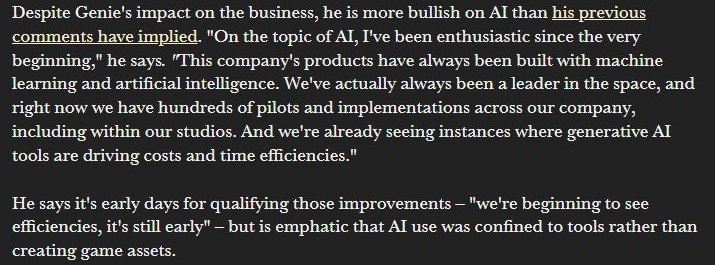
We cannot check from outside how the game was made. What we can read is the line he draws: AI inside the studio’s tools, no generative AI in the world the player sees.
Steam draws the same line
Every game on Steam goes through a Content Survey before review. Its third section covers generative AI, and Valve’s own documentation says:
- “Efficiency gains through the use of these tools is not the focus of this section.”
- “Instead, it is concerned with the use of AI in creating content that ships with your game, and is consumed by players. This includes content such as artwork, sound, narrative, localization, etc.”
Valve then splits that content in two:
- Pre-Generated: “Any kind of content that ships with your game and is consumed by players that is created with the help of AI tools during development.” Valve says it evaluates it “the same way we evaluate all non-AI content”.
- Live-Generated: “Any kind of content created with the help of AI tools while the game is running.” Same rules, plus one more: you must tell Valve “what kind of guardrails you’re putting on your AI to ensure it’s not generating illegal content.”
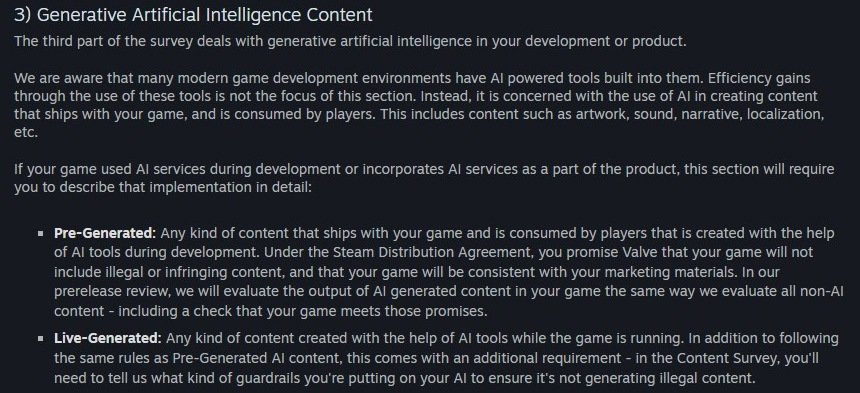
Two details matter. The section also says that if your game used AI services during development or includes them in the product, “this section will require you to describe that implementation in detail”. And Valve’s FAQ is clear that the survey is no shield: products “must adhere to the content rules, regardless of whether it is disclosed”. Valve’s reviewers also compare your answers with what is actually in your build and on your store page.
So the question every game developer has to answer is the same one Take-Two answered in public: what in this game was made by AI, and what reaches the player?
The playbook: an AI ledger in 5 steps
An AI ledger is a simple table, kept with your project, that records every piece of content that ships and whether AI touched it. It is a small habit, not a project: one row per asset, filled in as you work. It gives you three things: an honest Steam answer, a quick reply when a player asks, and a clear record if a question about rights ever comes up.
Prerequisites
- The list of what your game ships: art, music, sound, voice, dialogue, localization, UI text, and your store page assets.
- A spreadsheet, or a CSV file in your repository.
- Python 3 if you want to run the script in step 5 (we tested it with Python 3.14.0).
Step-by-Step
1. List everything that ships. One row per asset or per group of assets. If the player sees it, hears it or reads it, it gets a row. Do not skip the store page: Valve compares your answers with it.
2. Put each row in one of four buckets.
| Bucket | What it means | Examples | What Steam asks |
|---|---|---|---|
| human-only | No AI touched it | your hero sprites, your main theme | nothing about AI |
| tool-only | AI helped the team, nothing it made ships | a coding assistant drafting tests, build scripts, bug triage | Valve says efficiency gains are not the focus, but describe any AI service you used if the survey asks |
| pre-generated | AI helped make content that ships | a translated first draft, a generated sound loop | describe it in the Content Survey |
| live-generated | AI makes content while the game runs | an NPC that answers players with a language model | describe it and list your guardrails |
3. Decide what stays handcrafted. This is the GTA lesson, and it is a product decision, not a legal one. Ask what the player is paying for. In a narrative game it is the writing, so dialogue stays human-only. In a pixel-art game it is the art. Mark those rows human-only on purpose and treat it as a rule for the whole team, not a default you drift away from.
4. Fill the ledger as you work, not at the end. Use these columns. The last one is the most important: what a person did after the AI.
asset,type,bucket,ai_tool,what_ai_did,human_review
hero_sprites.png,art,human-only,,,
main_theme.ogg,music,human-only,,,
dialogue_en.json,narrative,human-only,,,
dialogue_es.json,localization,pre-generated,LLM translation,first draft of all Spanish strings,native speaker reviewed every line
ambient_rain.ogg,sound,pre-generated,AI sound generator,generated the rain loop,edited and mixed by hand
shopkeeper_chat,dialogue at runtime,live-generated,hosted LLM,answers player questions about items,blocklist + output moderation + off switch in settings
ItemDataTests.cs,code,tool-only,coding assistant,drafted data validation tests,read and edited before commit
5. Turn the ledger into your Steam draft. Save this as ledger_to_survey.py next to the CSV:
import csv
import sys
from collections import defaultdict

LABELS = {
    "pre-generated": "Pre-Generated (made with AI during development, ships with the game)",
    "live-generated": "Live-Generated (made by AI while the game runs)",
    "tool-only": "Development tools only (nothing they made ships to players)",
}

rows = list(csv.DictReader(open(sys.argv[1], encoding="utf-8")))
groups = defaultdict(list)
for r in rows:
    groups[r["bucket"].strip()].append(r)

human = [r["asset"] for r in groups.get("human-only", [])]
print(f"Handcrafted, no AI: {', '.join(human) or 'none'}\n")
for bucket, label in LABELS.items():
    if bucket not in groups:
        continue
    print(label)
    for r in groups[bucket]:
        print(f"- {r['asset']} ({r['type']}): {r['what_ai_did']} (tool: {r['ai_tool']}). Human step: {r['human_review']}.")
    print()

unknown = sorted(set(groups) - set(LABELS) - {"human-only"})
if unknown:
    print(f"Check these buckets, they are not valid: {', '.join(unknown)}")
    sys.exit(1)
Run python ledger_to_survey.py ai_ledger.csv. With the sample above, it prints:
Handcrafted, no AI: hero_sprites.png, main_theme.ogg, dialogue_en.json

Pre-Generated (made with AI during development, ships with the game)
- dialogue_es.json (localization): first draft of all Spanish strings (tool: LLM translation). Human step: native speaker reviewed every line.
- ambient_rain.ogg (sound): generated the rain loop (tool: AI sound generator). Human step: edited and mixed by hand.

Live-Generated (made by AI while the game runs)
- shopkeeper_chat (dialogue at runtime): answers player questions about items (tool: hosted LLM). Human step: blocklist + output moderation + off switch in settings.

Development tools only (nothing they made ships to players)
- ItemDataTests.cs (code): drafted data validation tests (tool: coding assistant). Human step: read and edited before commit.
We also added a row with a typo in the bucket (“pre-genrated”). The script named it and stopped with an error code, so a typo cannot quietly drop an asset from your answer. Use the output as a draft and rewrite it in your own words before you paste anything into the survey.
If you have live-generated content
Valve asks for your guardrails but does not give a checklist. These are the ones we would write down, as our own suggestion, not Valve’s: a filter on what players can send, moderation on what the model answers, a blocklist for your game’s sensitive topics, logs you can review, and a setting that turns the feature off. Then test it the way a bored teenager would.
Who should care, who can ignore
If you plan to sell on Steam, or already do, start the ledger today, even if every row says human-only. That is still an answer, and a strong one if your game is sold on its art or writing.
Solo developers and small teams gain the most, because nobody else will remember in six months which sound loop came from where.
If you only make games for yourself or for a game jam, you can skip it for now.
Our take
“Handcrafted” is turning into a selling point. A huge publisher can say it out loud and still run hundreds of AI pilots behind the scenes, because the line is between the tools and the world the player buys. An indie can make the same promise, and make it believable, by doing the boring part: knowing exactly what AI touched, and saying so.
Sources
- Rockstar Newswire, “Grand Theft Auto VI Now Available” (19 Nov 2026)
- GamesIndustry.biz, interview with Strauss Zelnick by Jon Hicks (3 Feb 2026)
- Steamworks Documentation, Content Survey (read 20 Nov 2026)
- AI Mind Center test of the ledger script, 20 Nov 2026