













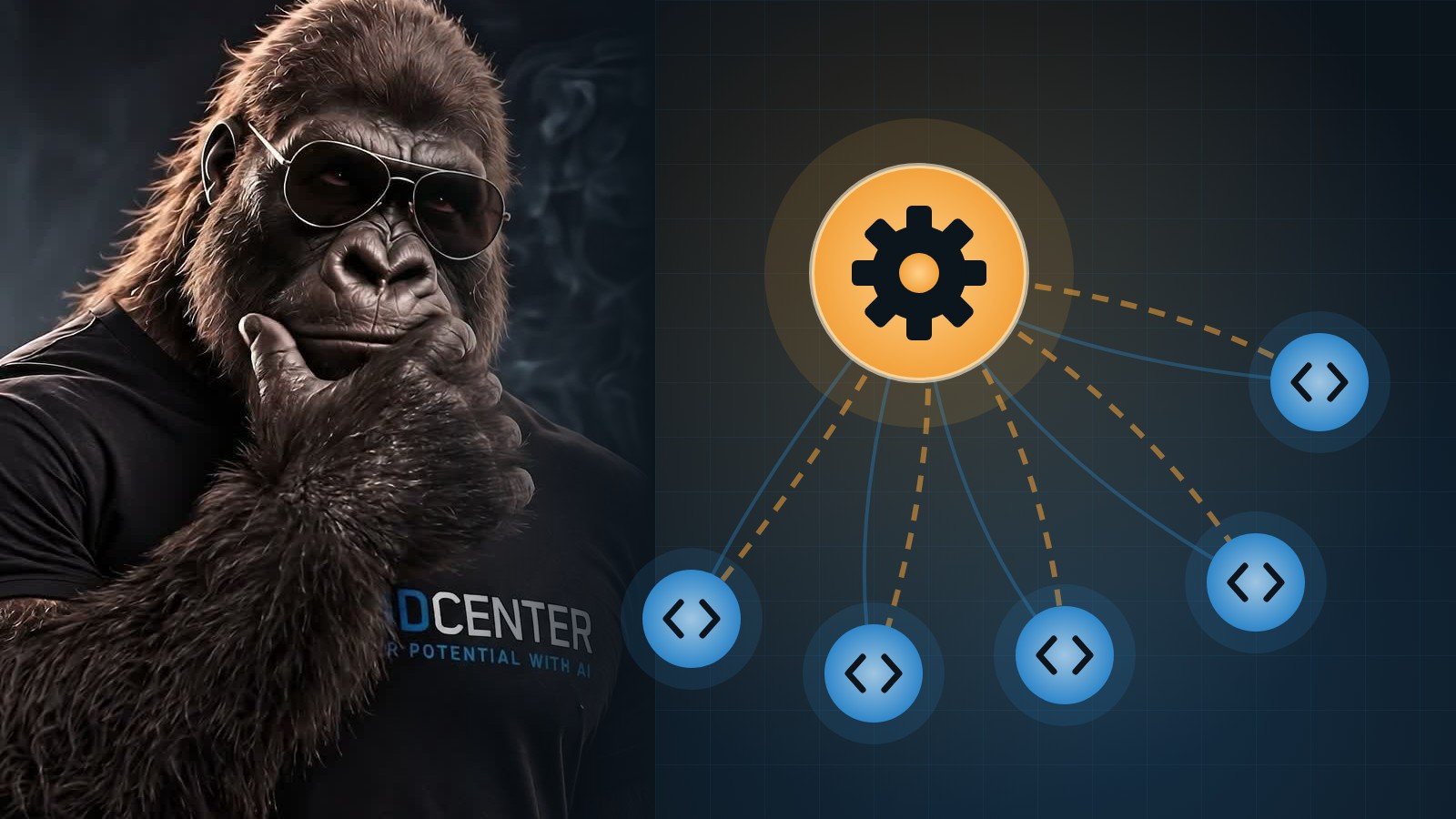
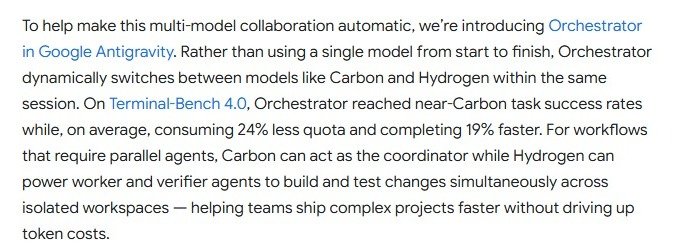
Google’s top model, Gemini 4 Carbon, doubles its API price on December 1. On November 12, alongside Hydrogen, Google announced a feature called Orchestrator: let the expensive model plan, and let a cheaper one do the building. Google claims this uses 24% less quota and finishes 19% faster, on average.
That is a claim, not a result we measured. Below is how the pattern works, what the numbers do and do not say, and how you can copy the idea today through the API without an Ultra subscription.
What Orchestrator actually does
Think of a small team with three roles. Google’s Antigravity announcement describes them like this:
- Explore. Carbon “can start in a read-only phase to explore dependencies”. It looks around and builds a plan without changing anything.
- Execute. Gemini 4 Hydrogen, the cheaper model, “could then take over to write edits, update packages, and run tests.”
- Recover. “If Hydrogen hits friction, it would hand back to Carbon to inspect the state, repair the plan, and resume execution.”
Google’s blog adds that Orchestrator “dynamically switches between models like Carbon and Hydrogen within the same session.” For parallel agents, Carbon coordinates while Hydrogen runs the worker and verifier agents.
If you already hand work to AI agents, this is the same shape as a human team: a senior person scopes the job, a faster person does the typing, and the senior person is called back when something breaks. The savings come from the expensive model spending its tokens on thinking, not on every file edit.
The numbers, and what they don’t say
Google says that on Terminal-Bench, Orchestrator “reached near-Carbon task success rates” while “consuming 24% less quota and completing 19% faster” on average.
Three honest caveats:
- It is Google’s own claim. We found no independent test.
- The sources disagree on the benchmark. The Antigravity post says Terminal-Bench 4.1, the Google blog says 4.0. Same percentages, so probably a typo, but we cannot confirm which is right.
- Quota is not dollars. Google measured quota, not your API bill, and gives no dollar figure for the saving. We will not invent one.
Also, “near-Carbon” means slightly below Carbon. You trade a bit of success rate for less quota.
Carbon versus Hydrogen on price
These are the official prices per 1M tokens, from Google’s pricing pages.
| Carbon until Nov 30 | Carbon from Dec 1 | Hydrogen | |
|---|---|---|---|
| Input | $2.00 | $4.00 | $1.50 |
| Output (incl. thinking) | $10.00 | $20.00 | $7.50 |
| Cached input | $0.10 | $0.20 | $0.075 |
| Free tier | No | No | Yes, rate-limited |
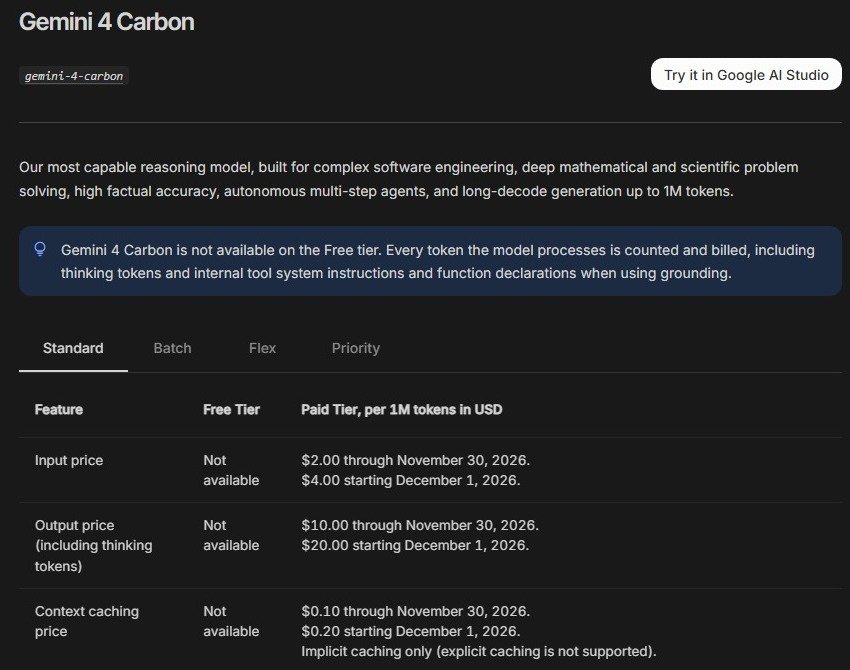
Our arithmetic: from December 1, Carbon output at $20 is about 2.7 times Hydrogen at $7.50. Carbon input at $4 is also about 2.7 times Hydrogen at $1.50. That is the gap the planner/executor pattern tries to exploit: pay the high rate only for the planning turns.
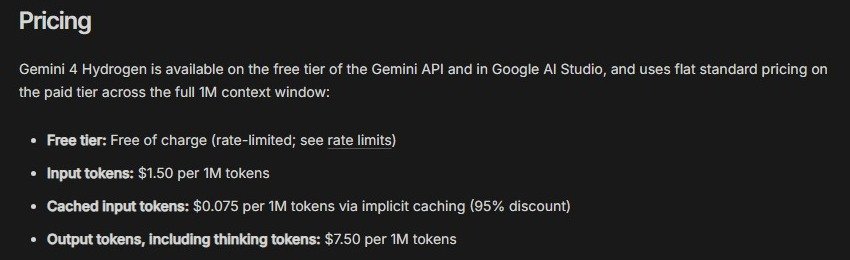
One more detail: Hydrogen’s price is flat across its whole 1M-token window (1,048,576 tokens shared by input, thinking and output), and its output price includes thinking tokens. Check your own workload before assuming the cheaper model lowers your bill.
How good is the cheap model? On Google’s model card, Hydrogen leads on some agent benchmarks and trails on others:
| Benchmark | Hydrogen | Claude Sonnet 5.5 | GPT-6.1 Terra |
|---|---|---|---|
| Terminal-Bench 4.1 (cheating-adjusted) | 57.0% | 63.9% | n/a |
| Agents’ Last Exam v1.1 | 71.6% | 60.4% | 69.8% |
| AutomationBench-AA | 76.1% | 71.8% | 60.2% |
| Vending-Bench 2 (bank balance) | $14,549 | $11,165 | $9,107 |
| OSWorld-2.1 (offline subset) | 77.6% | 83.9% | 74.2% |
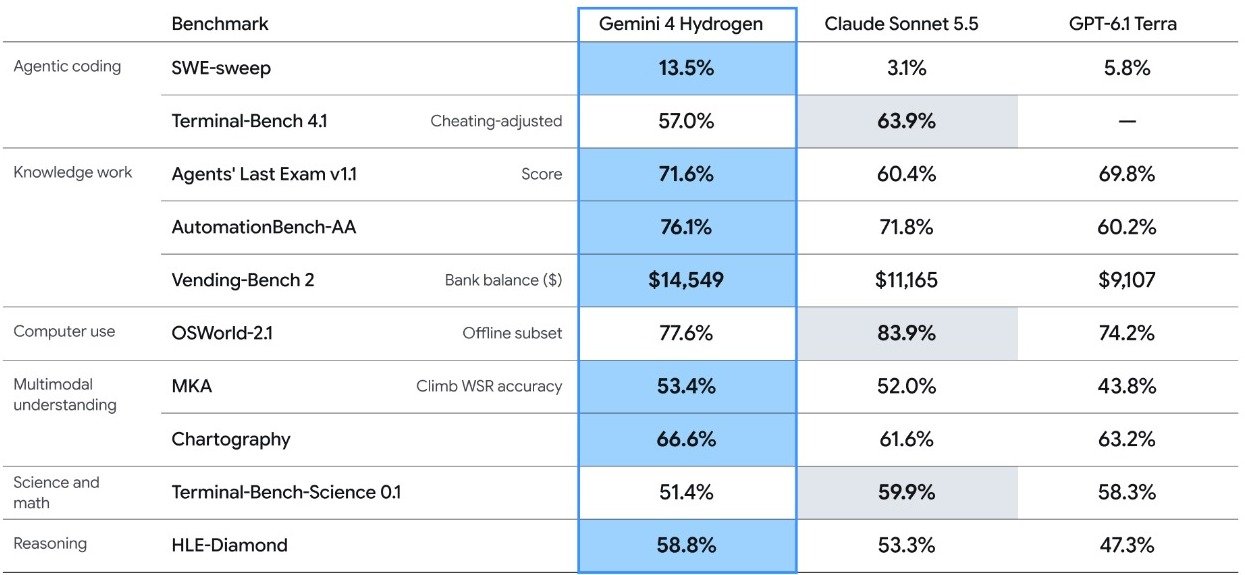
Hydrogen loses to Sonnet 5.5 on Terminal-Bench and OSWorld. These are Google’s published figures, not our tests. Google also says Hydrogen scores 57% on Terminal-Bench 4.1 against 18.2% for Gemini 3.8 Flash, and finishes tasks 2.5 times faster at its default “high” reasoning level.
Copy the pattern without Ultra
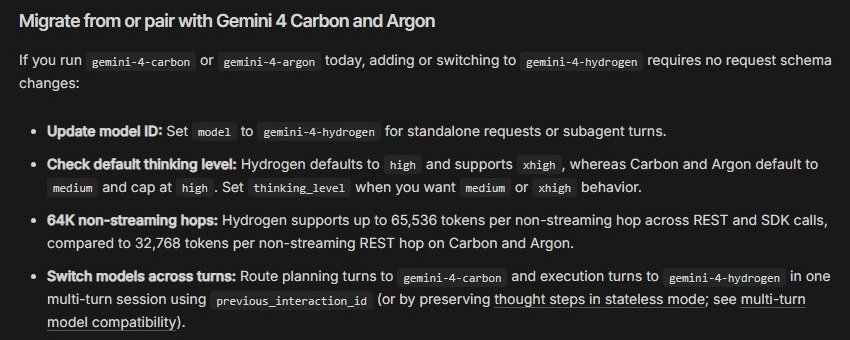
Orchestrator itself is a product feature. But the API docs describe the same idea: route planning turns to Carbon and execution turns to Hydrogen in one session.
Prerequisites
- Python 3 and a Google AI Studio API key. The Hydrogen free tier is rate-limited, so you can start without paying. Carbon has no free tier.
- The package:
pip install google-genai
Step-by-step
- Install the package with the command above.
- Run the official quickstart for Hydrogen. This is copied as published:
from google import genai

client = genai.Client()

interaction = client.interactions.create(
    model="gemini-4-hydrogen",
    input="Build an interactive single-file HTML token bucket rate-limiter simulator with live sliders for burst size and request traffic."
)

print(interaction.output_text)- Planning turn: make the same kind of call with
gemini-4-carbonand ask only for a step-by-step plan, no code. - Execution turn: make the next call with
gemini-4-hydrogenand tell it to follow the plan. The docs say to chain turns usingprevious_interaction_id, or, in stateless mode, by preserving thought steps. See the AI Studio docs. - If Hydrogen gets stuck, send the problem back to Carbon for a repaired plan, then return to Hydrogen.
We have not tested steps 3 to 5. We are describing the documented parameter, not showing code, because we do not know the exact field name that holds the interaction id. Check the docs before building on it.
Who gets it
Per the Antigravity post, Orchestrator is rolling out as Orchestrator (Carbon) and Orchestrator (Argon) for Google AI Ultra subscribers, and only as Orchestrator (Argon) for paid Google AI Pro subscribers. Gemini 4 Hydrogen is rolling out across paid Pro and Ultra. Google’s AI Studio docs describe Argon as handling most long-horizon tasks with lower token use than Carbon.
Our take
The idea is sound and not new to anyone who delegates work to agents: do not pay senior rates for typing. If you run long coding or automation jobs, a planner/executor split is worth a small experiment, especially once Carbon costs 2.7 times Hydrogen.
It makes less sense if your tasks are short. A plan costs tokens too, and a one-file fix may not need Carbon at all. It also makes less sense if you need the best terminal or desktop-control results, where the model card shows Sonnet 5.5 ahead.
Our advice: do not trust 24% until someone independent measures it. Run the same three tasks with Hydrogen alone and with the split, and compare your own bill. Solo founders and app developers with a real monthly API cost are the people who gain most from that test.