














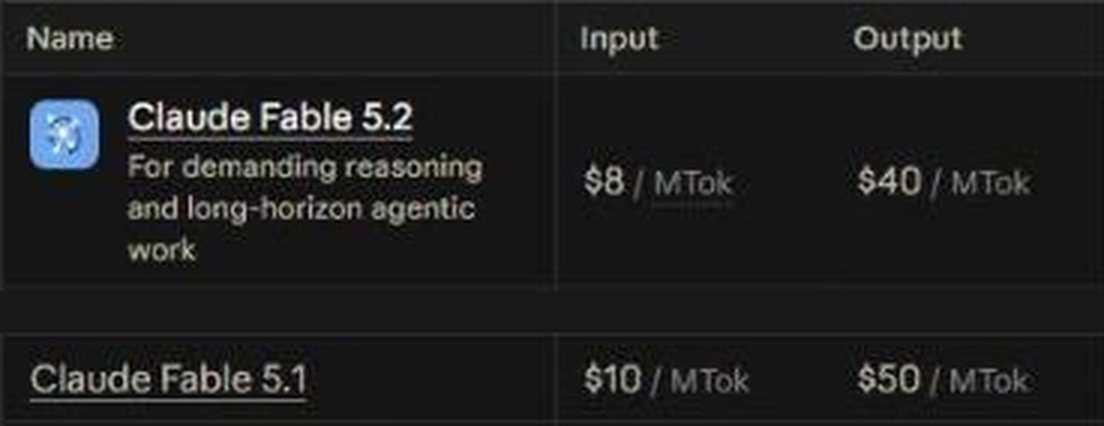
Claude Fable 5.2 costs $8 per million input tokens and $40 per million output tokens, against $10 and $50 for Fable 5.1. That is 20% less per token. On AutomationBench, Anthropic reports 51.4% for 5.2 against 31.4% for 5.1.
This post is for people who pay for the API and run agents: app developers, game developers, and solo founders who delegate work to agents the way you would delegate to staff. The price per token is the easy part. The setting that decides your real bill is effort, and the playbook below shows how to choose it and how to measure it on your own work.
The facts
- Price: Fable 5.2 is $8 input / $40 output per million tokens. Fable 5.1 is $10 / $50. (Claude Platform pricing docs)
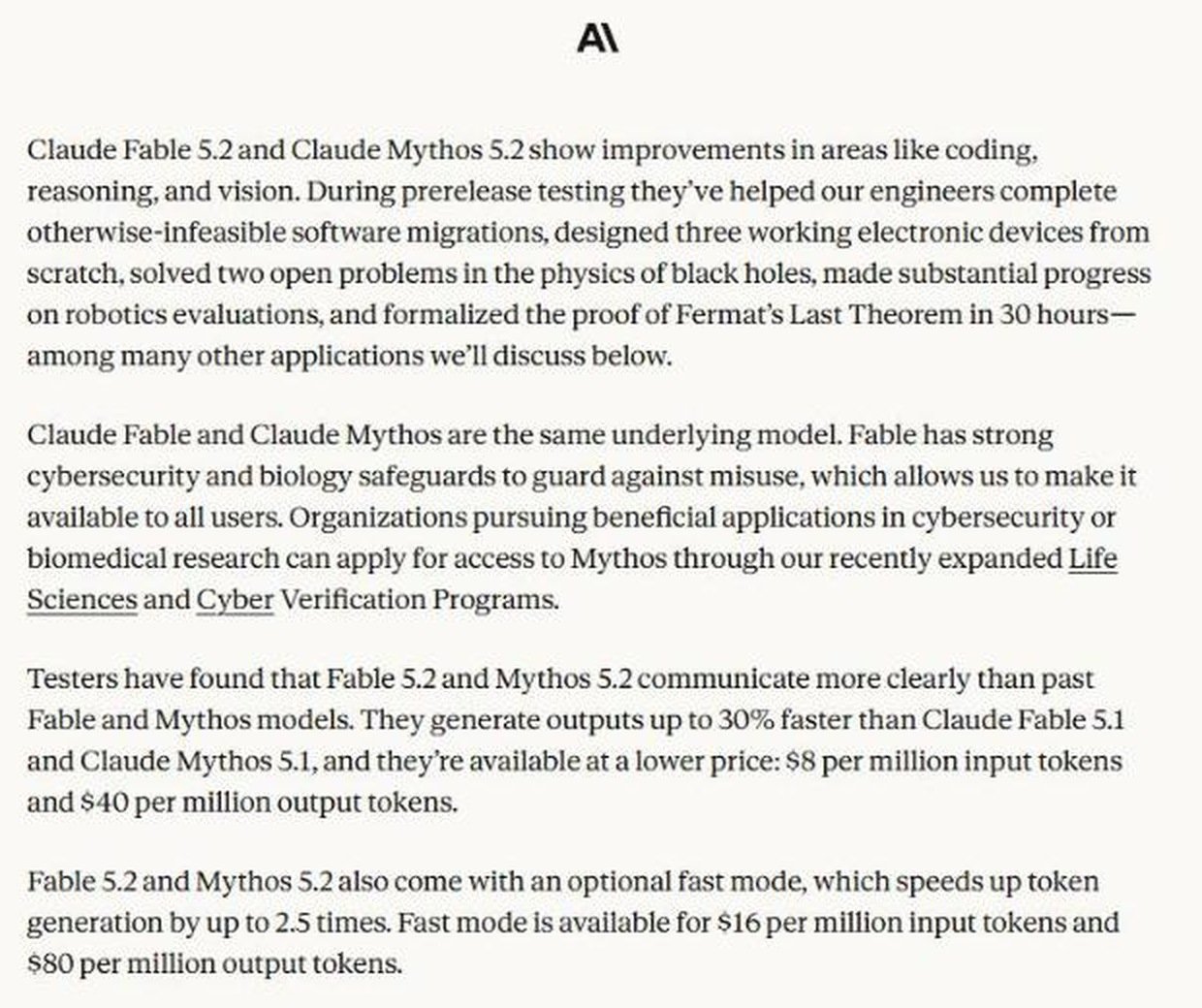
- Speed: up to 30% faster than 5.1. Fast mode costs $16 / $80 and is up to 2.5x faster. (Anthropic announcement)
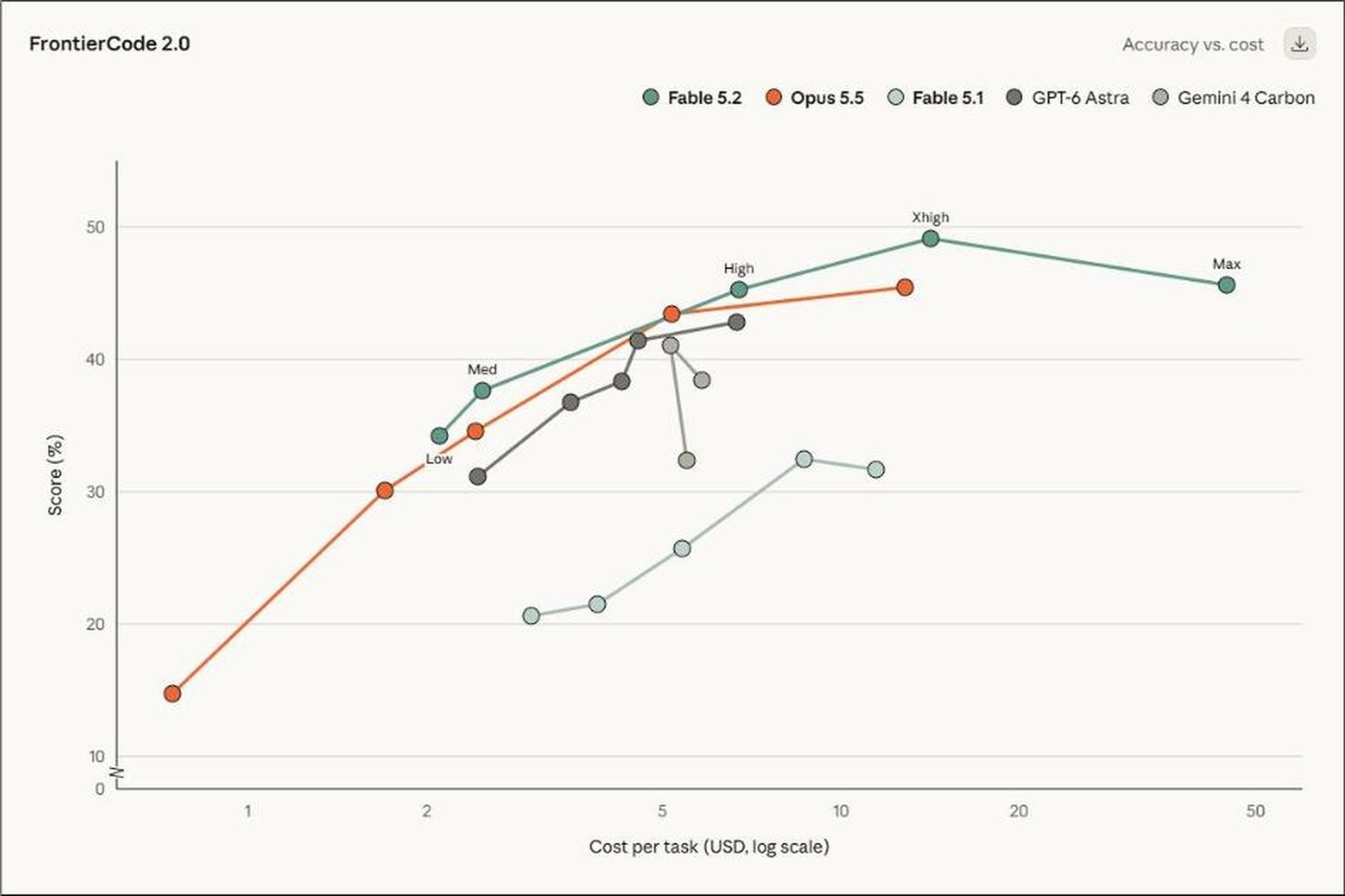
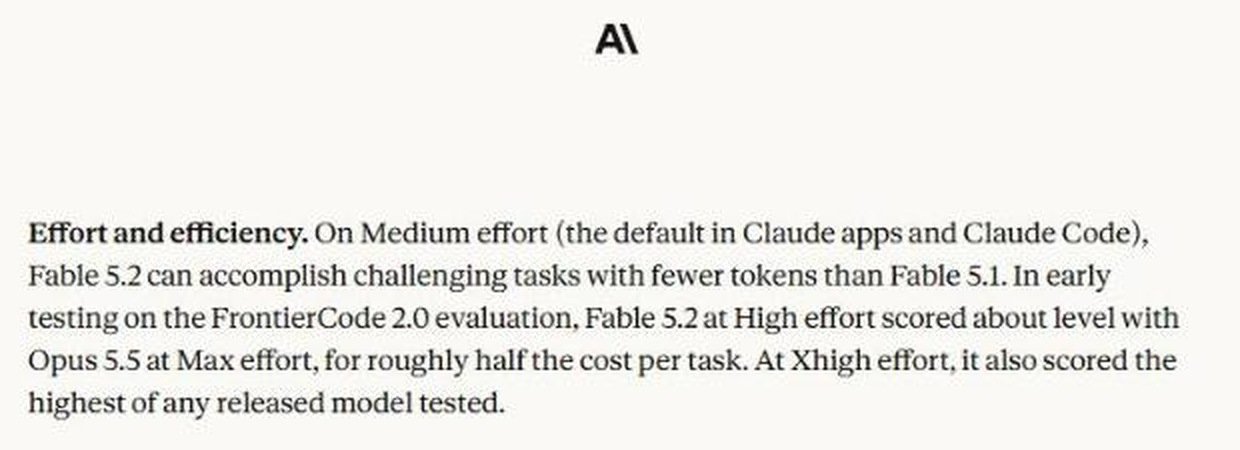
- Effort: at Medium, the default in the apps and in Claude Code, it handles hard tasks with fewer tokens than 5.1. In early testing on FrontierCode 2.0, High matches Opus 5.5 at Max (45.3% vs 45.5%) for about half the cost per task. At Xhigh it scores 49.1%, the highest of any released model Anthropic tested. (Anthropic announcement)
- Agents: AutomationBench (business workflows), from the announcement table: 51.4% for 5.2, 31.4% for 5.1. Anthropic shows each model at its highest available effort unless noted. (Anthropic announcement)
Before and after
| Per million tokens | Fable 5.1 | Fable 5.2 | Change |
|---|---|---|---|
| Input | $10 | $8 | -20% |
| Output | $50 | $40 | -20% |
| Fast mode (input / output) | not listed | $16 / $80 | n/a |
Lower is better in every row. The “Change” column is our arithmetic on the two official prices.
Why price per token is not cost per task
You pay for every token the model thinks, not only the ones you read. Effort sets how much it thinks, how long a turn takes, and how many tokens it uses. So the same task at two effort levels can have very different bills at the same price per token.
A small example, ours and not from Anthropic: a job that uses 1M input and 200k output tokens costs $10 + $10 = $20 on 5.1 prices and $8 + $8 = $16 on 5.2 prices, if the token counts were identical. They will not be identical. The model can think more or less at the same price per token, and that is the number you have to measure.
The official comparison makes the point. In Anthropic’s early testing on FrontierCode 2.0, Fable 5.2 at High reaches the Opus 5.5 at Max score for about half the cost per task. The saving comes from the effort level, not only from the price list.
The playbook
Step 1. Start at high
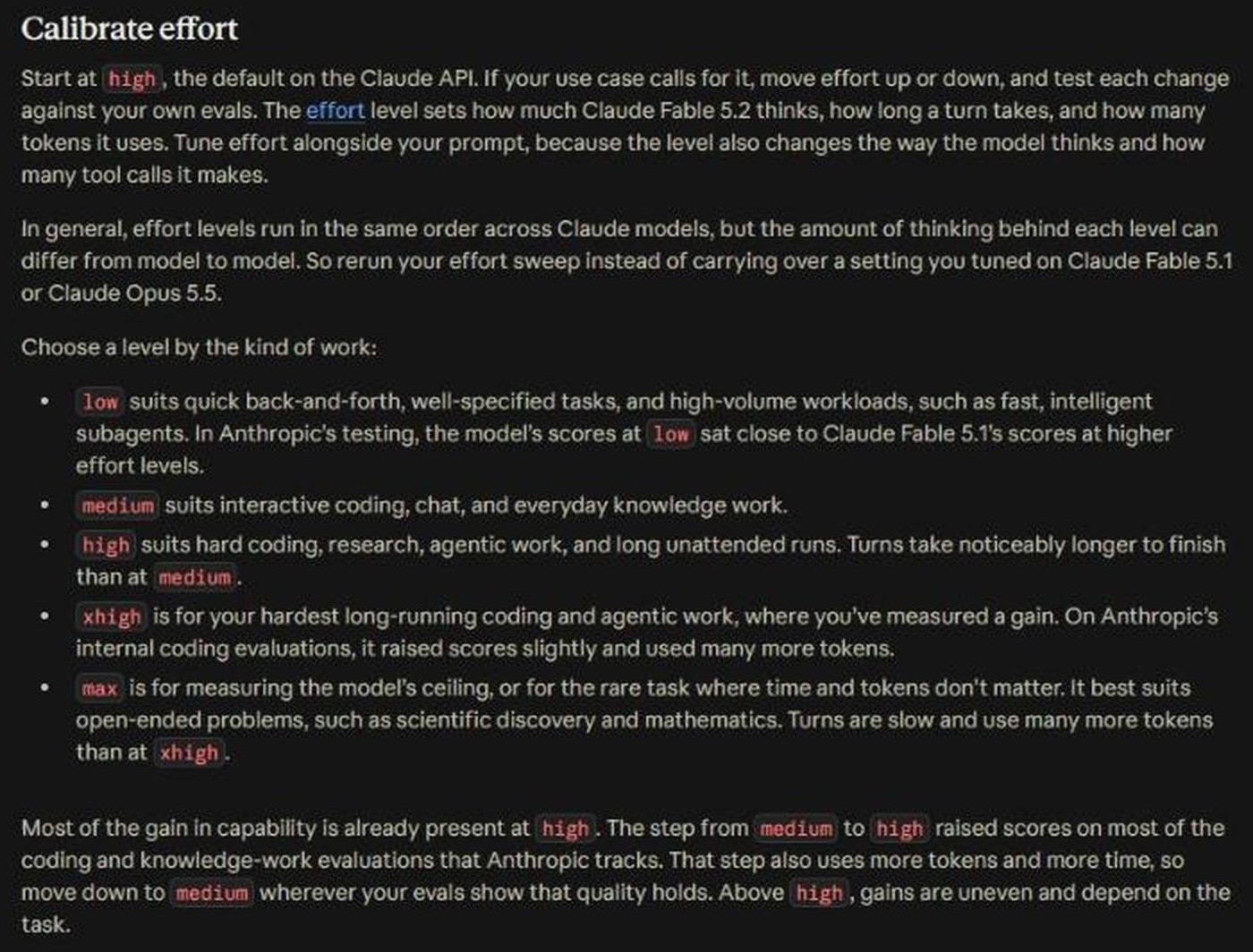
High is the default on the API, and Anthropic’s prompting guide says most of the capability gain is already present at high. Do not begin at max “to be safe”. Above high, the gains are uneven and depend on the task.
Step 2. Pick the level by type of work
This follows Anthropic’s own guidance for Fable 5.2:
| Effort | Use it for |
|---|---|
| low | Quick back-and-forth, well-specified tasks, high-volume work such as subagents. Anthropic says scores at low sit close to 5.1 at higher effort. |
| medium | Interactive coding, chat, everyday work. |
| high | Hard coding, research, agent work, long unattended runs. Turns take noticeably longer than at medium. |
| xhigh | Your hardest long-running coding and agent work, only where you measured a gain. It uses many more tokens. |
| max | Measuring the ceiling, or rare tasks where time and tokens do not matter. Slow, and many more tokens than xhigh. |
Step 3. Set it on the request
In the Messages API you set output_config.effort on the request. With no value, the model default applies, which is high for Fable 5.2. Anthropic’s documentation shows this pattern (the model name and level are ours, adapted to Fable 5.2):
response = client.messages.create(
    model="claude-fable-5-2",
    max_tokens=16000,
    messages=[{"role": "user", "content": "Your task here"}],
    output_config={"effort": "high"},
)
At high and above, the docs say to set a large max_tokens, because it is a hard limit on thinking plus reply text. In Managed Agents, effort goes on the agent’s model object or in a session’s model override. The effort page also has tabs for other SDKs, including C#. Check them there for the exact syntax before you copy anything.
Step 4. Run your own effort sweep
Do not carry over the setting you tuned for 5.1 or for Opus 5.5. The levels run in the same order across models, but the amount of thinking behind each one differs. Here is a sweep you can do in an afternoon:
- Collect 20 to 50 real tasks from your own work: prompts, the files they touch, and a clear pass or fail check. Use what your agents actually do, not public benchmarks.
- Run the whole set at low, medium, high and xhigh. Change only effort. Keep the prompt and tools fixed.
- Record for each run: pass rate, total tokens (input and output), and time per task.
- Compute cost per task with the 5.2 prices ($8 / $40), not cost per token.
- Pick the cheapest level whose pass rate you accept. Move up one level only where the gain pays for the extra tokens. Repeat the sweep when you change the prompt, because Anthropic notes the level also changes how the model thinks and how many tool calls it makes.
Step 5. Mix levels in one workflow
You do not need one level for everything. Anthropic’s example: plan and iterate at medium, then raise effort for the long unattended part. To change levels inside a conversation without losing the prompt cache, there is a per-message effort change, which is in beta and needs a header. See the effort docs for the platforms where it is available.
What it changes for agents and subagents
If you already delegate work to agents, think of effort as how much time you let each employee spend before answering. Easy requests do not need your most expensive thinking.
- Orchestrator: High is the starting point for agent work. Anthropic says Fable 5.2 can act as Orchestrator, delegating simpler tasks to smaller models.
- Subagents: low is the recommended starting point for fast, high-volume subagents. Test it. Anthropic notes agents at low or medium effort are more likely to stop early, so its guide suggests adding a “finish the whole task” instruction there.
- Do not rely on “think less” prompts. Anthropic says a line like “answer directly without deliberating” did not stop 5.2 from thinking at medium and above. Lower the effort level instead.
- Do not copy the old harness. Anthropic recommends reviewing system prompts and skills written for 5.1 or Opus 5.5.
On AutomationBench, 51.4% against 31.4% is a higher score on Anthropic’s business-workflow benchmark, with each model at its highest available effort. It does not tell you your cost. Your sweep does.
Who can ignore this
- If you only chat with it in the apps, Medium is already the default and you have nothing to set.
- If you do not use the API, the price change does not reach you directly.
- If your workload is small, the sweep costs more attention than it saves. Start at high and move on.
Our take
The 20% cut is real, but it is the smaller lever. The effort level changes your bill more, and the only reliable way to pick it is to measure on your own tasks.
Sources
- Anthropic, “Claude Fable and Mythos 5.2”: https://www.anthropic.com/claude-fable-and-mythos-5-2
- Claude Platform Docs, Pricing: https://platform.claude.com/docs/en/about-claude/pricing
- Claude Platform Docs, Prompting Claude Fable 5.2 (Calibrate effort): https://platform.claude.com/docs/en/build-with-claude/prompt-engineering/prompting-claude-fable-5-2
- Claude Platform Docs, Effort: https://platform.claude.com/docs/en/build-with-claude/effort
All first-party sources, checked on 10 Nov 2026. The worked cost example and the five-step sweep are our own.