



















On November 23, Z.ai released GLM-5.4, which it calls its first flagship Loop Transformer. It runs 28 layers of the GLM-5 base model for two iterations, at 750B scale, and Z.ai says it reaches “intelligence levels comparable to 2T-3T parameter models.” The Hacker News thread reached 1134 points. The catch: Z.ai published no benchmark table for GLM-5.4 itself.
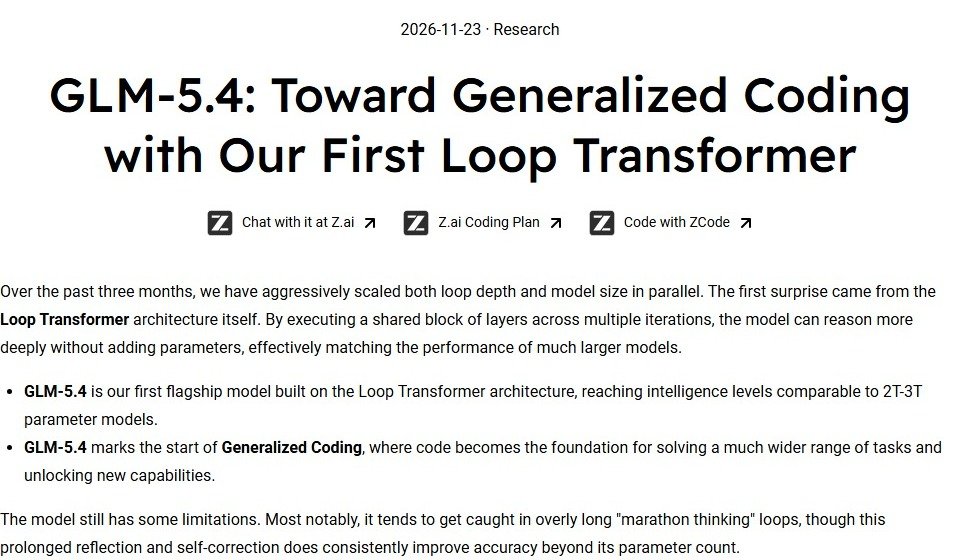
Source: Z.ai
We did not test GLM-5.4. Everything below comes from Z.ai’s blog and docs, and the second half is a method for you to test it yourself.
The facts
- Z.ai blog: GLM-5.4 is built on a Loop Transformer, a shared block of layers executed across multiple iterations. It was not trained from scratch. A pretrained base was adapted with continued training.
- Z.ai blog: three changes make the loop practical: gated progressive updates, a hybrid KV cache, and reuse of sparse attention indices. Per Z.ai, an extra loop “only costs one sliding window of KV cache rather than a full context cache.”
- Z.ai blog: the design was validated on 1B, 4B, 30B and 750B bases. Z.ai cites the Universal Transformer as the earlier idea.
- Z.ai blog: up to 200 tokens/s off-peak and 70 to 80 tokens/s at peak. Z.ai admits the model “tends to get caught in overly long ‘marathon thinking’ loops.”
- Z.ai docs: 1M context, 128K max output, function calling, structured output, context caching. Available to all GLM Coding Plan users (Personal and Team), and, for plans with a weekly quota, 1.5x the GLM-5.3 quota. Also in ZCode and Z.ai Chat.
- Z.ai blog: API is “Coming Soon”. Weights: “We plan to open-source the model weights responsibly after completing necessary safety hardening.” No date, no API price.
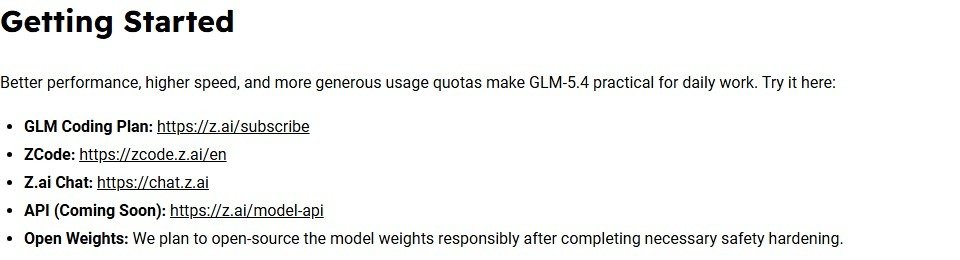
Source: Z.ai
The loop in one paragraph: instead of stacking more unique layers, the model sends the data through the same middle block twice, so it gets more depth without more parameters. Our 21 November post on Inkling 2 Mini already explained how looping works. Two looped models in one week is a trend worth watching, not yet a result.
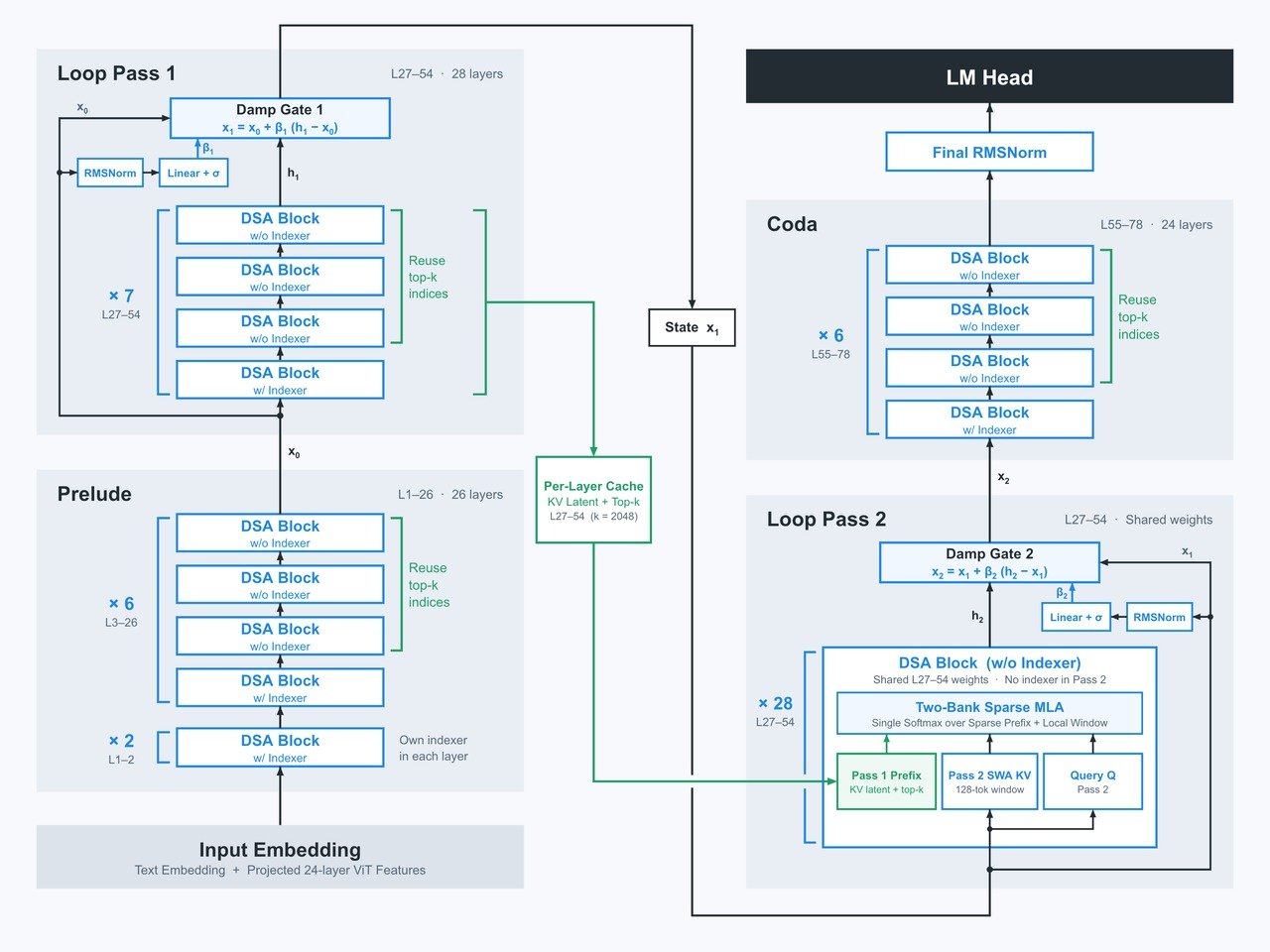
Source: Z.ai
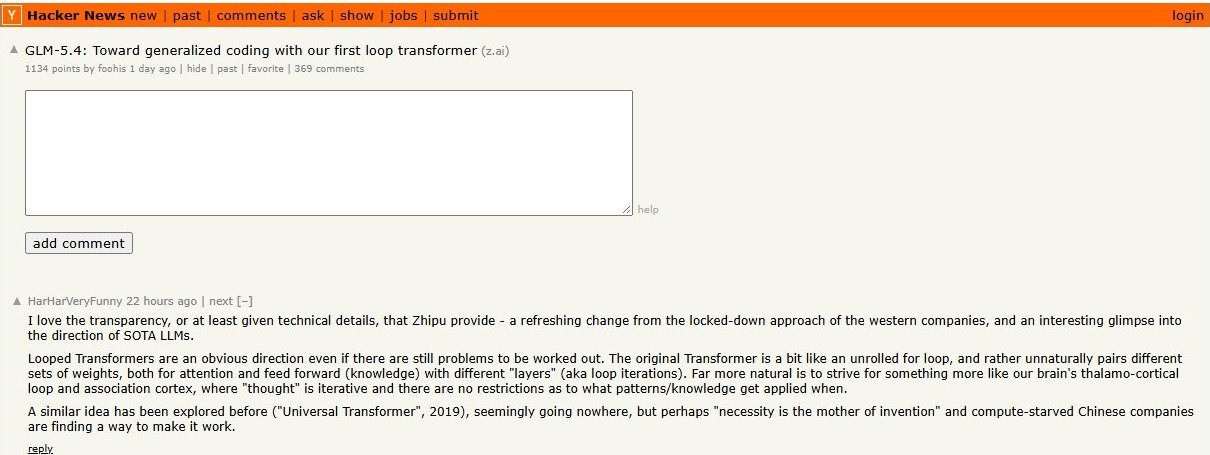
Source: Hacker News, screenshot by us
How to read Z.ai’s charts without being fooled
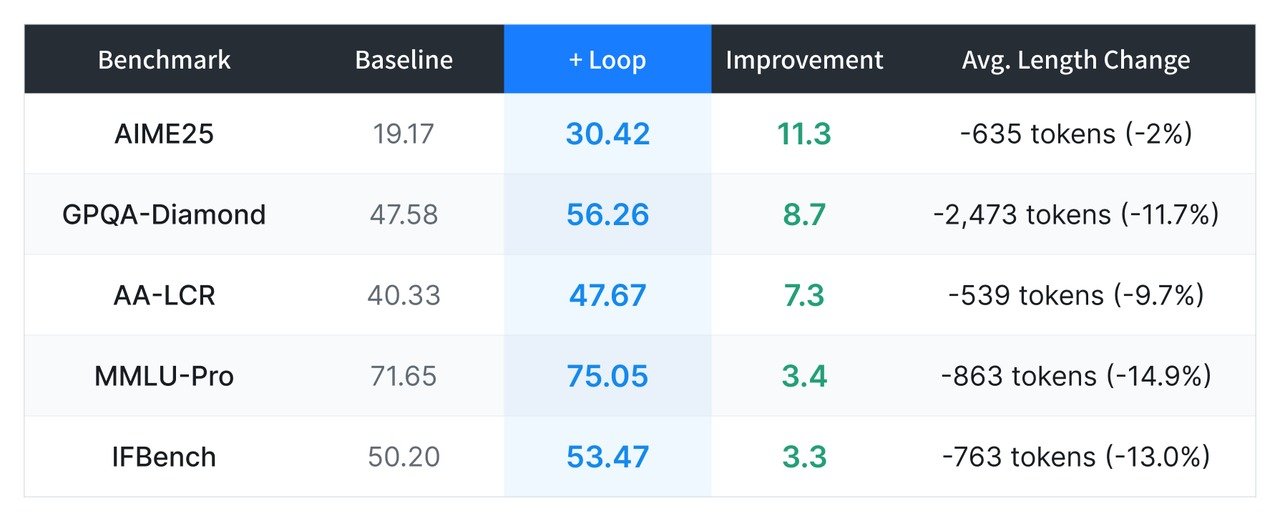
The ablation table is not GLM-5.4. It is an iso-parameter experiment on a 30B test model, with about 10% more total training compute, in thinking mode.
Source: Z.ai
It shows the loop helps a small model on math, science and long-context tests, and that outputs got shorter. It says nothing about GLM-5.4 on your code.
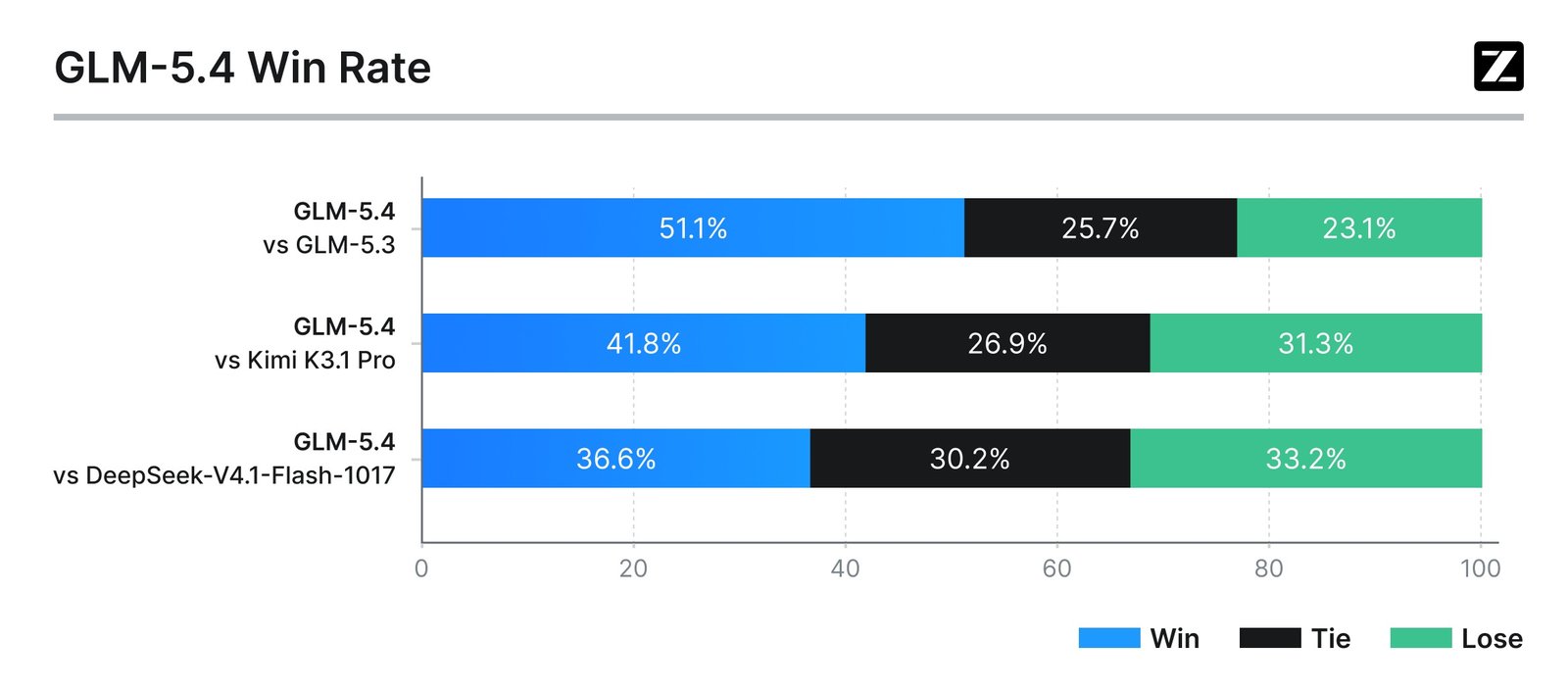
The win rate chart has no method. GLM-5.4 wins 51.1% against GLM-5.3, 41.8% against Kimi K3.1 Pro, and 36.6% against DeepSeek-V4.1-Flash-1017. Ties are 25.7%, 26.9% and 30.2%. Z.ai does not say which tasks, how many, or who judged. Against the two rivals, GLM-5.4 wins more than it loses, but the margin is 10.5 and 3.4 points on an unexplained test.
Source: Z.ai
“2T-3T” is a claim. No method is published. Treat it as marketing until someone measures it.
What it changes: run a 5-task benchmark before you switch
This is for anyone who delegates coding to an agent: app developers, game developers, and solo founders whose agent is the main engineer. Picking the wrong model costs you a week of friction. Five of your own tasks cost about an afternoon. The thresholds below are our suggestions, not measured values.
Prerequisites
- GLM Coding Plan access, and the coding tool you already use with it. Z.ai’s docs say GLM-5.4 can be accessed “through your preferred coding tools” (see Z.ai’s docs). Check that your tool lists GLM-5.4 before you start.
- Your current coding model in the same tool or an equivalent one.
- A git repo with a test command that exits with code 0 on success.
- Python 3 (standard library only, no packages needed).
Step-by-Step
1. Pick five tasks from your own repo. Use real work you already solved, so you know what a good result looks like.
- A bug fix with a failing test.
- Write tests for an untested class.
- A small refactor (rename, extract, move).
- A long-context task that touches many files.
- Game developers: a shader, physics or gameplay task. Everyone else: a second bug fix.
2. Fix the prompt. Write each prompt in a file (prompts/task1.txt and so on) and never edit it between models. Same prompt, same repo state, same tool settings.
3. Reset the repo for every run. Create one branch per run, for example bench/glm-5-4/task1, starting from the same commit.
4. Run each task on both models and record it. Save this as bench.py next to your repo. It times your agent command, runs your tests and appends a row to results.csv. It does not need to know your tool, so you pass the command yourself.
import csv, os, subprocess, sys, time

# usage: python bench.py MODEL TASK "AGENT_COMMAND" "TEST_COMMAND"
model, task, agent_cmd, test_cmd = sys.argv[1:5]

start = time.time()
subprocess.run(agent_cmd, shell=True)
seconds = round(time.time() - start)

passed = subprocess.run(test_cmd, shell=True).returncode == 0

tokens = input("Output tokens (from your tool, blank if unknown): ")
interventions = input("Times you had to step in: ")
marathon = input("Marathon thinking? (y/n): ")

new = not os.path.exists("results.csv")
with open("results.csv", "a", newline="") as f:
    w = csv.writer(f)
    if new:
        w.writerow(["model", "task", "seconds", "tests_passed",
                    "output_tokens", "interventions", "marathon"])
    w.writerow([model, task, seconds, passed, tokens, interventions, marathon])
5. Measure the same five things every time.
| Task | Model | Tests pass | Seconds | Output tokens | Interventions | Marathon thinking |
|---|---|---|---|---|---|---|
| 1 Bug fix | current | |||||
| 1 Bug fix | GLM-5.4 | |||||
| 2 Tests | current | |||||
| 2 Tests | GLM-5.4 | |||||
| 3 Refactor | current | |||||
| 3 Refactor | GLM-5.4 | |||||
| 4 Long context | current | |||||
| 4 Long context | GLM-5.4 | |||||
| 5 Game or bug fix | current | |||||
| 5 Game or bug fix | GLM-5.4 |
“Marathon thinking” is the limitation Z.ai itself names, so mark any run where the model reasons far longer than the task deserves. If your quota allows, run each task twice. One run of a language model is noisy.
6. Apply a decision rule. Our suggestion, decided before you see the numbers:
- Switch if GLM-5.4 passes at least as many tasks as your current model and needs fewer interventions overall.
- Stay if it passes fewer tasks, or if marathon thinking shows up in 2 or more of the 5 tasks and your time per task is higher.
- If it is a tie, keep what you have. Switching has a cost.
Who should ignore this
If your agent already passes your tests with your current model, skip it for now. Without an API or a price, you also cannot compare cost per task. Solo founders paying per token should wait for that.
When to rerun
Rerun the five tasks when Z.ai ships the API with a price, or when the weights open. Both are promised, neither has a date. Z.ai also says a “significantly larger” model is “ready soon”, so keep your prompts and results.csv. Reusing them next time takes minutes.
Sources
- Z.ai, “GLM-5.4: Toward Generalized Coding with Our First Loop Transformer” (Nov 23, 2026): https://z.ai/blog/glm-5.4
- Z.ai docs, GLM-5.4: https://docs.z.ai/guides/llm/glm-5.4
- Hacker News discussion (1134 points): https://news.ycombinator.com/item?id=50609685
- AI Mind Center, Inkling 2 Mini (Nov 21, 2026): https://aimindcenter.com/inkling-2-mini-run-locally-coding-agent/
- Charts and screenshots are from Z.ai’s blog and docs (Source: Z.ai). The Hacker News screenshot is ours.